

Countertop cooking often forces a compromise between preheat speed and usable baking area. Standard ovens consume significant power and heat entire kitchens, while compact countertop units frequently struggle with hot spots or cramped vertical clearances. Investing in toaster ovens convection models helps circulate heated air around sheet pans, but picking the right unit depends heavily on heating element tech, fan speeds, and internal chamber layouts.
This guide compares capacity, exterior dimensions, and heating controls across leading designs to help match your daily meal routine with the right machine. Whether you need rapid air circulation for roasting or precise heat distribution for baking, understanding airflow mechanics will ensure your counter space is well utilized. For broader comparisons across standard models, explore our guide to toaster ovens best for daily meals.
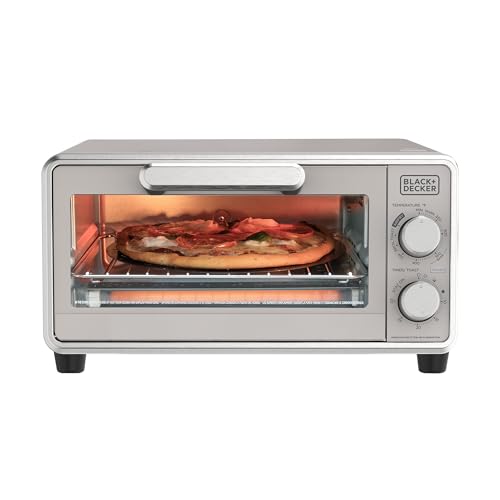
Pros
- Compact footprint fits small counter spaces easily
- Includes PFAS-free ceramic-coated baking pan and accessories
- Five preset cooking modes provide practical task versatility
Cons
- Four-slice capacity limits cooking for larger households

Pros
- Independent top and bottom element control
- Integrated digital food probe with automatic shutoff
- PFAS-free ceramic nonstick grill and griddle plate
- Dishwasher-safe racks and removable crumb tray
Cons
- Large 20-inch exterior footprint demands significant counter space

Pros
- Nine versatile cooking presets including convection baking
- Spacious interior fits six slices or 13-inch pizza
- Five quartz heating elements distribute heat evenly
- Includes baking pan, broiling rack, and pizza pan
Cons
- Large 18.9-inch wide footprint occupies substantial counter space
- Heavier build at 18.7 pounds makes relocation difficult
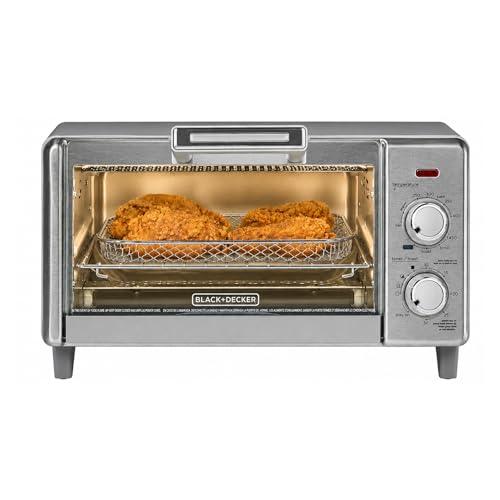
Pros
- Five cooking functions in one compact appliance
- Includes dedicated air fry mesh tray and bake pan
- EvenToast technology designed for consistent browning
- Removable crumb tray simplifies routine cleanup
Cons
- Thirty-minute timer restricts longer baking tasks
- Interior limited to nine-inch pizzas or four slices
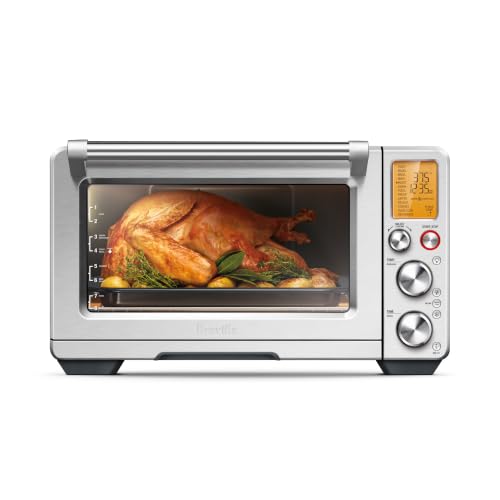
Pros
- Spacious interior fits standard Dutch ovens and turkeys
- Thirteen distinct settings expand cooking versatility
- Two-speed convection fan enables rapid, even heating
- Includes five dedicated cooking trays and racks
Cons
- Heavy 30-pound frame makes moving difficult
- Large footprint demands substantial countertop space

Pros
- Flips up to reduce counter footprint when stored
- Accommodates 12-inch pizza or six bread slices
- Broad temperature range between 85 and 450 degrees
- Includes air fry basket, sheet pan, and crumb tray
Cons
- Shallow vertical clearance prevents cooking tall foods
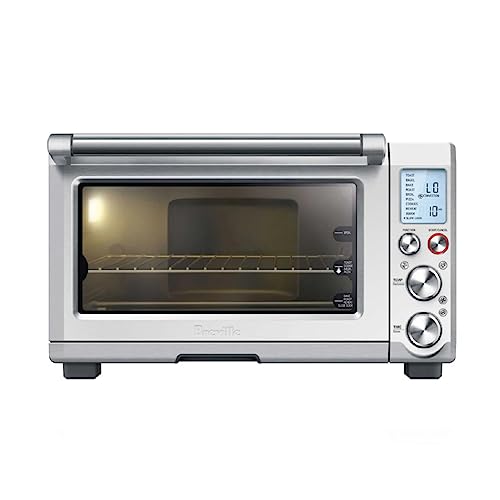
Pros
- Ten cooking functions including dedicated slow cook mode
- Convection fan reduces overall cooking duration
- Spacious interior accommodates 13-inch pizzas and Dutch ovens
- Replaceable interior light aids visibility during cooking
Cons
- Heavy 22.8-pound weight limits easy portability
- Large footprint requires substantial countertop space

Pros
- Four cooking functions in compact countertop footprint
- Accommodates four bread slices or nine-inch pizza
- Removable slide-out crumb tray simplifies routine cleaning
- Includes bake pan and broil rack accessories
Cons
- Timed cooking cycles cap at thirty minutes
- Interior fits maximum nine-inch pizza

Pros
- Fits full twelve-inch pizza or six toast slices
- Five cooking functions in one countertop machine
- Includes air fry basket, bake pan, and rack
- Removable crumb tray simplifies interior cleanup
Cons
- Substantial 18 by 16 inch footprint requires counter space
- Mechanical timer caps timed cooking at sixty minutes
Buying Guide: How to Select Toaster Ovens Convection
Internal Usable Capacity and Bakeware Clearance
Manufacturer slice ratings can be misleading because bread sizes vary significantly across bakeries. Instead of relying purely on slice metrics, inspect the maximum pan dimensions and vertical height above the lowest rack position. Units like the Breville BOV900BSS Smart Oven Air Fryer Pro provide 16 x 13.5 x 7 inches of interior clearance, fitting standard 9 x 13-inch baking pans with handles and taller items like Dutch ovens.
Conversely, compact options like the BLACK+DECKER 4-Slice Air Fry Toaster Oven accommodate up to a 9-inch pizza or four slices, fitting tight prep zones without consuming working counter depth. If you routinely bake pies or roast whole chickens, measure your favorite roasting dishes before deciding on internal cavity boundaries.
Heating Element Technology and Temperature Regulation
Heating element composition affects preheating speed and surface browning uniformity. Basic calrod elements heat steadily but respond slowly to thermostat adjustments, whereas quartz elements react quickly to thermal demand. The Breville BOV800XL Smart Oven and Breville BOV845BSS Smart Oven Pro utilize five independent quartz elements alongside algorithms that direct wattage where needed, compensating for cold spots near door seals.
Alternative designs, such as the Ninja Flip Toaster Oven & Air Fryer, 8-in-1, employ six infrared elements to support a broad temperature range between 85°F and 450°F. If you frequently switch between slow roasting, delicate dehydration, and high-heat broiling, look for appliances featuring digital microprocessors rather than purely mechanical bi-metallic thermostats.
Convection Airflow and Variable Fan Speeds
Convection fans strip the boundary layer of cooler air surrounding food, accelerating cooking times and crisping exterior surfaces. Basic convection systems operate at a single fixed velocity, which works well for sheet pan dinners but can dry out delicate pastries or blow lightweight parchment paper out of place. More advanced units introduce dual-speed or ultra-fast fans to widen cooking versatility.
For cooks focused on frying textures, multi-speed airflow provides a distinct advantage. The Breville BOV900BSS Smart Oven Air Fryer Pro includes a super convection mode that maximizes volume for air frying and dehydrating up to four trays simultaneously. If crispiness is your main priority, consider reviewing our dedicated toaster ovens air fryer comparison for deeper airflow analysis.
Countertop Footprint and Storage Mechanics
Countertop appliances require adequate overhead clearance from wall cabinets to safely dissipate exhaust heat during broiling cycles. If prep room is scarce, a permanently positioned large-capacity unit may limit space for cutting boards. Some modern frames tackle this trade-off by incorporating specialized storage hinges.
The Ninja Flip Toaster Oven & Air Fryer, 8-in-1 flips upward against the kitchen backsplash when not running, reducing its active counter footprint by roughly 50%. Meanwhile, French-door configurations like the Gourmia Toaster Oven – 6-Slice Capacity use dual central-opening doors, requiring less outward swing space than large single-drop doors.
Interior Maintenance and Crumb Removal
Frequent roasting and air frying inevitably splash grease across hot interior walls. Nonstick interior coatings, found on units like the Breville BOV800XL Smart Oven, allow grease to wipe away with damp microfiber cloths once the unit cools completely. Bare galvanized metal interiors demand harsher scrubbing and accumulate baked-on splatters more quickly.
Look for front-accessible, slide-out crumb trays. Models such as the BLACK+DECKER Crisp ‘N Bake Pro 4-Slice Digital Air and Nuwave Bravo XL Pro Air Fryer Toaster Oven w/Grill feature pull-out trays that slide forward without needing to lift or tilt the hot oven after cooking.
How We Compared These Products
This comparison is based on published technical specifications, manufacturer dimensions, power ratings, and verified product documentation rather than hands-on testing. We analyzed internal rack dimensions, quartz versus metallic element arrangements, stated wattage, fan systems, and included tray accessories. We also reviewed aggregate customer feedback to identify practical usability factors, including cleaning accessibility, door spring mechanisms, and intuitive interface layouts.
Which Option Fits Your Kitchen?
For cooks who prepare large-format meals or seek to replace an inefficient full-size oven, the Breville BOV900BSS Smart Oven Air Fryer Pro offers significant interior clearance. Its 16 x 13.5 x 7-inch cavity handles 9 x 13-inch bakeware, a 14-pound turkey, or multi-level dehydration trays, supported by independent quartz elements and dual-speed convection fans. If you want similar temperature control in a slightly smaller form factor, explore our review of toaster ovens Breville models.
If workspace conservation is your primary challenge, the Ninja Flip Toaster Oven & Air Fryer, 8-in-1 provides a unique storage profile. It folds upright against your backsplash to reclaim 50% of its counter footprint, while still managing a 12-inch pizza or six slices of bread when lowered. For tight spaces that require an affordable, static unit, the BLACK+DECKER 4-Slice Air Fry Toaster Oven delivers essential air circulation and toasting in a minimal housing, detailed further in our look at toaster ovens Black and Decker options.
For cooks who want multi-zone heat control and specialized grilling features, the Nuwave Bravo XL Pro Air Fryer Toaster Oven w/Grill provides tailored heating adjustments. It allows users to manipulate the top-and-bottom element power split between 0% and 100%, includes an integrated digital meat probe to automate internal doneness monitoring, and comes with a ceramic nonstick grill plate.
Frequently Asked Questions
How does a convection toaster oven differ from a standard countertop oven?
A convection oven integrates an internal fan and exhaust system that continuously circulates hot air around food. Standard radiant models rely on natural thermal convection, which leaves pockets of stagnant, cooler air near the edges. Active circulation accelerates surface moisture evaporation, helping foods brown faster and cook more evenly at lower set temperatures.
Should I reduce baking temperatures when using the convection setting?
Because circulating hot air transfers heat to food surfaces more efficiently than stationary air, standard baking recipes generally require an adjustment. A practical baseline rule is reducing the recipe temperature by 25°F or reducing the stated cooking duration by roughly 20% to 30%, checking for doneness early in the process.
Can standard metal bakeware and glass dishes be used inside these units?
Metal sheet pans, ceramic dishes, and cast-iron vessels rated for high oven temperatures are generally suitable, provided they do not contact the walls or heating elements. However, many thermal glass manufacturers caution against using glass bakeware inside compact countertop ovens because close proximity to radiant quartz or calrod elements can induce thermal shock.
What is the benefit of quartz heating elements over metal coil rods?
Quartz heating elements respond substantially faster to electrical input, reaching peak operating heat within seconds. This allows digital control systems to pulse element zones on and off to maintain tight internal temperatures. Traditional tubular metal coils take longer to warm up and retain residual heat longer after shutoff.
How much overhead clearance is necessary around a countertop convection oven?
Countertop convection ovens vent thermal exhaust through top and side vents during high-heat broil or roast cycles. Most instruction manuals recommend leaving at least four to six inches of clear space between the sides and top of the unit and adjacent walls or upper cabinetry to avoid heat damage.
Is an integrated air fryer setting identical to a dedicated basket air fryer?
Both appliances rely on high-velocity convection fans paired with intense heat sources. However, countertop convection ovens feature broader horizontal wire racks that let you spread food out in a single layer without crowding, while basket air fryers concentrate airflow within a smaller, deeper bucket that requires periodic manual shaking.



Write Your Review
No reviews yet. Be the first to share your experience!