

Countertop real estate vanishes quickly when separate appliances handle daily toast, quick reheating, and small-batch baking. Combining these jobs into a single unit sounds simple, but heating mechanisms vary widely. Some models rely on magnetrons with convection fans, while others prioritize exposed heating elements that excel at browning bread.
Choosing the right toaster oven microwave combo requires understanding how heating styles alter cooking speeds, pan clearances, and daily cleanups. This guide reviews key specifications across 10 models from brands like BLACK+DECKER, Ninja, TOSHIBA and more to help you pick the best balance of footprint and utility for your kitchen.

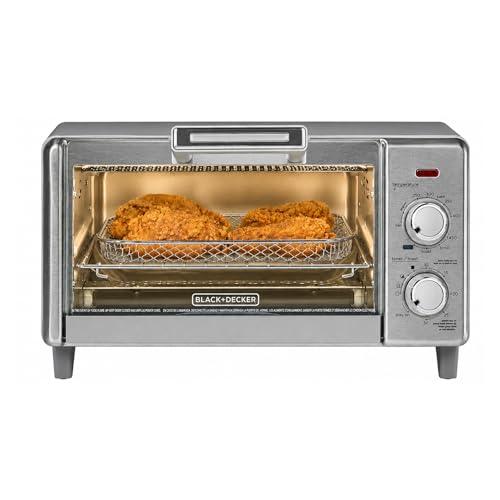
Pros
- Five cooking modes including air fry and convection
- Eleven dedicated air fry preset options
- Compact footprint for small countertop spaces
- Child-lock safety setting disables control panel
Cons
- Compact 0.9 cubic foot capacity limits larger cookware
Pros
- Five cooking functions in one compact appliance
- Includes dedicated air fry mesh tray and bake pan
- EvenToast technology designed for consistent browning
- Removable crumb tray simplifies routine cleanup
Cons
- Thirty-minute timer restricts longer baking tasks
- Interior limited to nine-inch pizzas or four slices

Pros
- Combines microwave, air fryer, convection oven
- Ten selectable power levels
- Five one-touch menu presets
- 1500W convection cooking power
Cons
- Heavy 42-pound weight complicates moving
- Deep 21.25-inch footprint requires substantial counter space
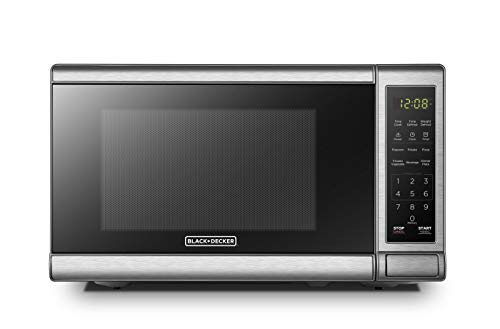
Pros
- Compact exterior fits tight countertop spaces
- Ten adjustable power levels provide heating control
- Removable ten-inch glass turntable simplifies cleaning
- Includes child safety lock for kitchen security
Cons
- Lower 700-watt power increases overall cooking times
- Small 0.7-cubic-foot interior limits oversized dishware

Pros
- Flips up to reduce counter footprint when stored
- Accommodates 12-inch pizza or six bread slices
- Broad temperature range between 85 and 450 degrees
- Includes air fry basket, sheet pan, and crumb tray
Cons
- Shallow vertical clearance prevents cooking tall foods
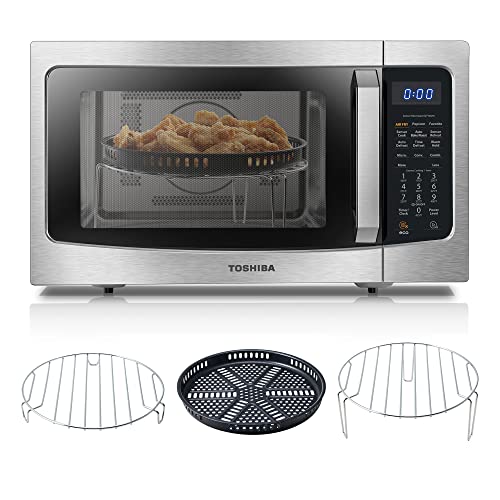
Pros
- Spacious 1.5 cubic foot interior with large turntable
- Combines microwave, air fryer, and convection cooking
- Easy to clean stainless steel interior
- Includes mute feature for keypad beeps
Cons
- Heavy unit weighing over forty-five pounds
- Large footprint requires substantial countertop depth

Pros
- Flips vertically against wall to save counter space
- Fast sixty-second preheat with eighteen hundred watt power
- Wide pan fits thirteen-inch pizza or nine toast slices
- Removable crumb tray and accessible back panel ease cleaning
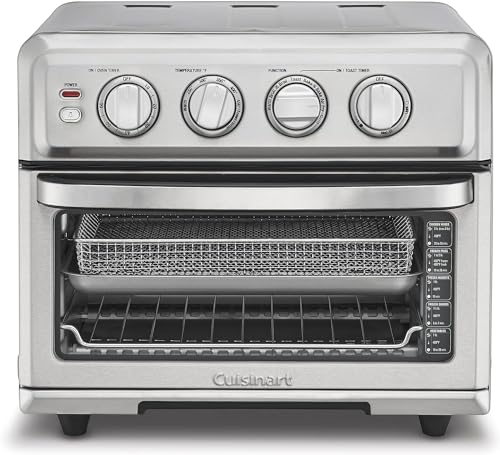
Pros
- Reversible ceramic nonstick grill and griddle included
- Accommodates 12-inch pizza or four-pound chicken
- Reaches 450 degrees with 60-minute auto-shutoff timer
Cons
- Weighs over 25 pounds, limiting easy movement

Pros
- Turntable-free flatbed interior fits 9x11-inch baking dish
- Dishwasher-safe glassware lacks PFAS, PTFE, and PFOA
- Combines microwave speed with 450-degree convection air frying
- Two-step child safety lock prevents accidental opening
Cons
- Heavy 50-pound unit takes up significant counter space
- Air fry modes require included specialized microwave glassware
Primary Heating Technology: Magnetron vs. Radiant Elements
Countertop hybrid appliances usually lean in one of two engineering directions. Microwave-first combinations use a magnetron paired with an auxiliary heating element or convection fan. Radiant-first units, similar to dedicated toaster ovens best suited for baking, depend on quartz or metal heating rods positioned above and below the food rack.
If your daily cooking relies heavily on boiling water, warming soup, and reheating leftovers quickly, a microwave-based unit provides essential convenience. However, if crisp toast, melted open-face sandwiches, and roasted vegetables are your priorities, exposed heating elements brown foods far more reliably than microwave convection combinations. Knowing your primary daily task prevents frustration with slow heating or pale crusts.
Turntable Systems vs. Flatbed and Wire Rack Interiors
Internal layout dictates which cookware fits inside the cavity. Rotating glass turntables assist microwave energy distribution, but they restrict pan geometry to circular shapes. Large rectangular baking sheets or standard casserole dishes often catch against the walls or jam the turntable mechanism during operation.
Flatbed microwave designs and traditional pull-out oven racks maximize square interior corners. For instance, the Ninja® Crispi™ Microwave & Air Fryer utilizes a turntable-free flatbed floor that accommodates a 9×11-inch baking dish. Before purchasing, measure the outer footprint of your most frequently used baking pans against the stated interior cavity dimensions.
Countertop Footprint and Vertical Clearance
Exterior dimensions determine how much prep area remains open on your counter. Units featuring high-powered air frying or convection modes exhaust hot air through top or rear vents, requiring several inches of clear space away from upper cabinets and backsplashes to prevent heat buildup.
For cooks working with narrow counters, specialized folding frames offer an alternative approach. The Ninja Flip Toaster Oven & Air Fryer, 8-in-1 and Ninja Digital Air Fry Countertop Oven, 8-in-1, XL both hinge upright against the wall when idle, freeing usable depth. If your layout allows zero storage flexibility, exploring dedicated compact options in our microwaves countertop buying guide helps clarify minimal spatial needs.
Accessory Requirements and Metal Restrictions
Operating a true combination unit requires attention to material safety. Microwaving requires glass, ceramic, or microwave-safe plastics, while radiant baking, air frying, and broiling demand metal trays, wire racks, and aluminum pans. Swapping inserts between steps adds complexity to quick meals.
Certain appliances supply dedicated multi-mode accessories. The GE GCST10A1WSS Countertop Microwave Oven provides designated metal racks for broiling and convection alongside an air fry crisper pan. Check included component lists carefully, as running metal tools during incorrect microwave cycles risks electrical arcing and cavity damage.
Cleaning Access and Crumb Management
Food splatters inside microwave cavities differ markedly from grease drippings and carbonized bread crumbs produced by toaster ovens. Smooth painted or stainless steel microwave interiors wipe down easily with a damp rag, but radiant units require accessible crumb trays to catch loose debris near bottom heating rods.
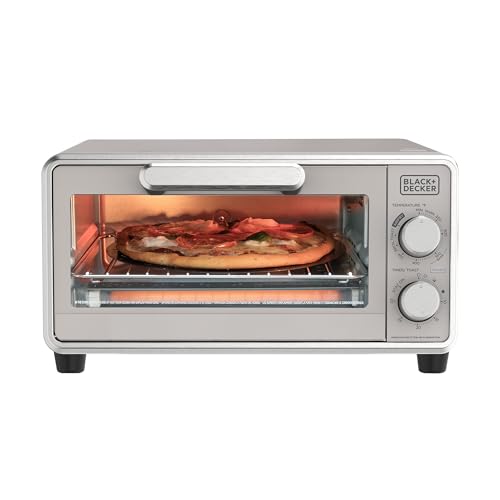
Ovens like the BLACK+DECKER 4-Slice Air Fry Toaster Oven feature dedicated slide-out crumb trays beneath the lower elements. When browsing appliances with heavy browning and air frying capabilities, verify whether internal accessories detach fully and check if rear walls can be reached without disassembling the housing.
How We Compared These Products
This guide is based on close analysis of manufacturer technical specifications, exterior dimensions, supported cooking modes, and listed accessory packages. Because hands-on testing was not conducted for this comparison, recommendations rely on published feature sets, wattage capabilities, interior capacities, and common operational trade-offs reported across verified product documentation.
Which Option Fits Your Kitchen?
For Reclaiming Counter Space in Tight Kitchens: If standard appliance depths block your preparation space, prioritize models with vertical storage. The Ninja Flip Toaster Oven & Air Fryer, 8-in-1 swings upward against your backsplash when idle, clearing surface area while still offering an 85 to 450 degree temperature range for baking, broiling, and toasting.
For Large-Capacity Microwave and Roasting Needs: When daily meals require cooking for multiple people, smaller cavities create bottlenecks. The TOSHIBA 4-in-1 Microwave Oven with Air Fryer features a spacious 1.5 cubic foot interior and a wide 13.6-inch turntable capable of rotating a 12-inch pizza, backed by a 1000-watt microwave system and convection cooking modes.
For Dedicated Microwave Reheating and Crisp Finishing: If you regularly transition food from cold storage to hot meals in one continuous step, look at specialized transition programming. The Ninja® Crispi™ Microwave & Air Fryer integrates flatbed microwave cycles with an automatic 1700-watt air fry finish, bypassing manual accessory swaps while maintaining glass-safe food preparation.
Frequently Asked Questions
Can a combination microwave make toast as well as a toaster oven?
Microwave-dominant units generally lack the direct radiant heat required to produce traditional dry, golden toast quickly. While convection or grill modes can brown bread over longer cycles, dedicated radiant toaster ovens with top and bottom heating elements toast bread much faster and more evenly.
Can I put metal pans inside a combination microwave oven?
Metal cookware is safe only during specific modes such as convection bake, broil, or air fry, provided the microwave function is completely inactive. Never place metal accessories inside the unit while standard microwave or combi microwave settings are running, as this will cause electrical arcing.
How much clearance is needed around these combination units?
Combination units generate substantial exterior heat during air fry, broil, and convection cycles. Most manufacturers advise maintaining at least 2 to 4 inches of open clearance on the sides and rear, along with several inches of overhead space to allow exhaust vents to dissipate heat safely away from cabinetry.
What is the benefit of a flatbed microwave over a turntable?
A flatbed design houses the microwave antenna underneath a stationary ceramic or glass floor. This setup eliminates the rotating turntable, allowing you to use rectangular baking dishes, multiple bowls, or odd-shaped bakeware that would otherwise hit interior side walls on a revolving tray.
Do air fry microwave combos require preheating?
Standard microwave functions do not require preheating. However, convection baking, roasting, and air frying modes benefit significantly from a short preheating cycle to bring the heating elements and internal cavity up to the target temperature before adding your food.


Write Your Review
No reviews yet. Be the first to share your experience!