

Nonstick convenience often comes with practical questions about coating durability, safe heating limits, and cabinet storage. When home cooks evaluate which ceramic cookware best suits their daily routine, the primary trade-off usually centers on whether to choose space-saving detachable handle sets or traditional fixed-handle pots designed for heavy stovetop use.
Finding the right balance requires evaluating heat conductivity, lid design, and the actual piece count in a box. This guide reviews 10 options from Astercook, CAROTE, SENSARTE to help you choose cookware matched to your cooking volume, cabinet space, and cleaning preferences.

Pros
- Detachable handles enable compact nesting and storage
- Compatible with induction, gas, and ceramic hobs
- Oven-safe cookware design with handles removed
- PFOA-free nonstick surface simplifies manual cleaning
Pros
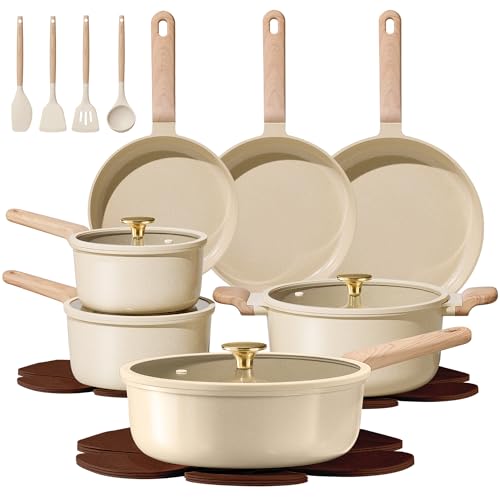
- Nonstick ceramic coating free of PFOA and PFOS
- Durable die-cast aluminum construction
- Airtight silicone lids contain steam and spills
- Comes with storage protectors and kitchen utensils

Pros
- Works on induction, gas, electric, and ceramic cooktops
- Detachable handles enable compact nested storage
- Includes storage lids, pan protectors, and utensils
- Ceramic coating made without PFOA and PFOS
Cons
- Only two removable handles included for five vessels

Pros
- Works on induction and all standard cooktops
- Coating free of PTFE, PFOA, PFAS, and lead
- Thick 4.8mm base heats quickly and evenly
- Stay-cool Bakelite handles provide comfortable grip
Cons
- Hand washing recommended to protect nonstick surface
Pros
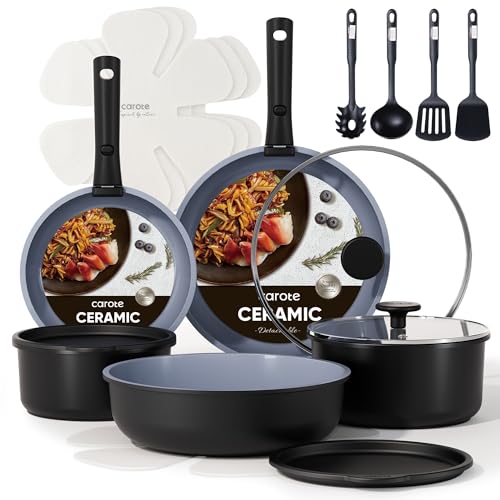
- Compact nested storage with handles removed
- Compatible with all cooktops, ovens, and grills
- Includes fridge storage lids and pot protectors
- Two removable handles included for multi-pan cooking
Cons
- Lids do not fit while handles are attached

Pros
- Die-cast aluminum build resists daily kitchen wear
- Silicone lids create airtight seal trapping steam
- Coating manufactured without PFOA or PFOS
- Includes four protective pads for nested storage
Cons
- Hand washing recommended over automatic dishwashing

Pros
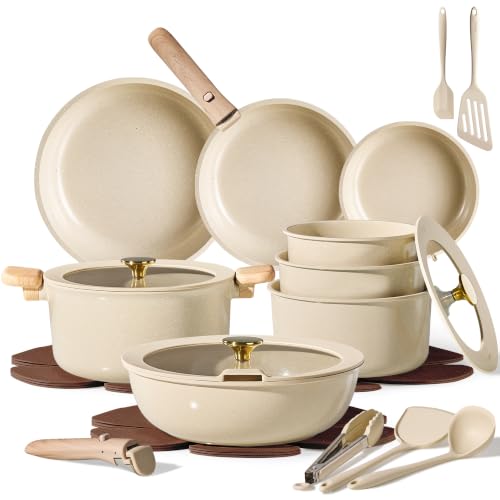
- Detachable handles save significant storage space
- Works on induction, gas, electric, and ceramic stovetops
- Ceramic nonstick surface cleans by hand or dishwasher
- Includes protective pan separators to prevent stacking scratches
Cons
- Only two detachable handles shared across eight vessels

Pros
- Integrated pour spouts facilitate clean liquid draining
- Silicone-rimmed glass lids seal tightly and prevent chipping
- Dishwasher-safe construction streamlines cleanup
- Includes utensils, silicone trivets, and pan protectors
Pros
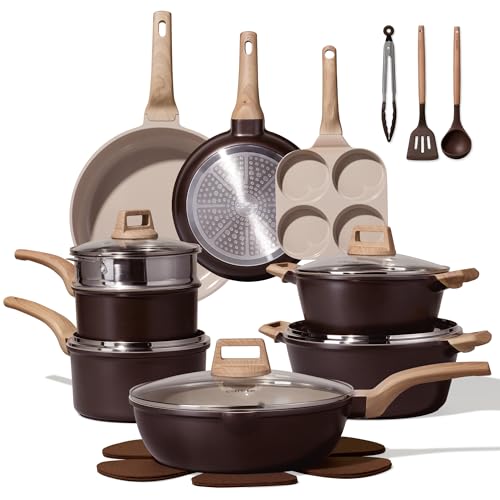
- PFOA and PFOS free ceramic nonstick coating
- Die-cast aluminum build resists daily wear
- Extensive 21-piece bundle covers most kitchen tasks
- Includes pan protectors for scratch-free storage
How to Find the Ceramic Cookware Best Suited to Your Kitchen
Handle Design: Fixed Versus Detachable Handles
Detachable handles allow cookware to stack tightly in cupboards, reducing required storage space by up to 70 percent. Removable systems also let pans move smoothly from stovetop burners into ovens or refrigerators. However, the trade-off is mechanical handling: you must clip and unclip the grip during multi-pan meals, and standard lids often cannot seal completely while a clamp-on handle remains attached. If you prefer continuous, one-handed maneuvering while searing or tossing vegetables, traditional riveted or screwed-on handles provide immediate stability without extra steps.
Base Construction and Stovetop Compatibility
Most ceramic pans use reinforced die-cast aluminum cores because aluminum heats rapidly and spreads warmth evenly across the base. If you cook on induction, verify that the pan bottom incorporates a bonded magnetic stainless steel plate. SENSARTE, for instance, uses a 4.8 mm thick stainless steel base to maintain reliable contact with magnetic elements. Cooks who switch between a dedicated non stick fry pan and fully clad stainless steel cookware sets will find that flat, heavy bases resist warping when transitioning between high heat and cooler countertop trivets.
Coating Formulation and Maintenance Demands
Ceramic coatings rely on mineral-derived sol-gel chemistry rather than fluoropolymer formulas, making them free of PFOA, PFOS, and PFAS. While slick enough for low-oil frying, ceramic layers remain more vulnerable to sudden thermal shock and abrasive cleaners than seasoned metal or enameled cast iron. Even when sets claim dishwasher compatibility, gentle hand washing with warm water and soft sponges protects the coating from chemical detergent erosion and prolongs food release properties.
Lid Design and Moisture Retention
Lid materials affect both cooking performance and cookware longevity. Silicone-rimmed glass lids create a quiet, airtight seal that locks in steam, prevents boil-overs, and cushions the glass against the ceramic rim to prevent chipping. In addition, sets configured with snap-on plastic or silicone storage lids allow cooking vessels to double as refrigerator containers, eliminating the need to transfer leftovers into separate storage bowls.
Set Composition Versus Usable Cookware
Manufacturers often inflate total piece counts by including utensils, silicone trivets, and felt pan separators. A 21-piece or 25-piece package may contain only five or six distinct cooking vessels. Before buying, focus on the core capacities you use most often, such as 2-quart saucepans, 10-inch skillets, and 5-quart stockpots. If your cooking routine regularly calls for searing meats at high temperatures or slow braising, pairing a ceramic set with traditional cast iron cookware provides versatile options for recipes that exceed standard nonstick heat thresholds.
How We Compared These Products
Our comparison is based on published technical specifications, verified material compositions, set inventory lists, and customer usage reports rather than hands-on laboratory testing. We analyzed pan dimensions, base thicknesses, handle latching mechanisms, and lid construction to help you identify which configuration meets your practical kitchen needs.
Which Option Fits Your Kitchen?
For compact spaces, apartments, and recreational vehicles, the CAROTE 19pcs Ceramic Cookware Set Detachable offers high utility. The removable handle system allows the pots and pans to nest compactly in shallow drawers, while the included fridge storage lids let you store leftover sauces and sides directly in the pan without dirtying separate containers.
If you prefer permanent handles with strong stovetop ergonomics, consider the SENSARTE Ceramic Cookware Sets. Its stay-cool wood-grain Bakelite handles require no assembly during cooking, and the 4.8 mm stainless steel bottom plate delivers even heat distribution across both gas burners and induction elements.
For large households that prepare multiple dishes simultaneously, the CAROTE 25pcs Ceramic Cookware Set delivers expansive pan variety. It provides three skillet sizes up to 12 inches alongside three separate saucepans and a 5.5-quart stockpot, giving you sufficient vessel options for batch cooking while preserving stackable storage flexibility.
Frequently Asked Questions
How does ceramic nonstick differ from traditional PTFE cookware?
Ceramic coatings are made from a silica-based mineral gel applied over a metal body, avoiding the use of PTFE, PFOA, and PFAS chemicals. Traditional nonstick coatings rely on fluoropolymers. While both provide smooth food release, ceramic surfaces generally require lower cooking temperatures and gentle cleaning to maintain slickness over time.
Can ceramic cookware be used on induction cooktops?
Only if the pan includes a magnetic base plate. Aluminum itself does not interact with induction coils, so manufacturers bond a stainless steel disc to the bottom of the pan to enable magnetic heating. Always confirm that the specific model specifies induction compatibility before purchasing.
Are detachable handles secure while carrying hot pans?
Detachable handles use mechanical locking clamps designed to latch tightly over the vessel rim. When fully locked according to manufacturer instructions, they support typical food loads safely. However, handles should be removed when placing pans inside the oven or when fitting flat storage lids in the refrigerator.
Is ceramic cookware dishwasher safe?
Some manufacturers state their ceramic cookware is dishwasher safe, but regular machine cycles accelerate surface dulling. Harsh detergents, high water pressure, and abrasive wash cycles degrade the mineral nonstick layer. Hand washing with a soft sponge and mild soap is recommended for maximum lifespan.
What utensils are safe to use on ceramic pots and pans?
Silicone, nylon, and wooden spoons or spatulas are safe for ceramic surfaces. Metal utensils like stainless steel spoons, whisks, and forks can chip or scratch the brittle mineral coating, leading to premature sticking and permanent surface damage.
Why do many ceramic cookware sets include felt pan protectors?
Felt protectors prevent direct metal-to-coating friction when nesting pans inside kitchen cabinets. Stacking unprotected ceramic pans can cause the rough exterior base of one pan to scratch the delicate nonstick cooking surface of the pan beneath it.


Write Your Review
No reviews yet. Be the first to share your experience!