

Standing in front of a stove with delicate eggs or a thick cut of meat highlights the core trade-off between cookware materials. Home cooks often struggle to choose between the slippery convenience of nonstick coatings and the searing capability of unlined metal surfaces. Deciding between ceramic cookware vs stainless steel comes down to how much oil you prefer to cook with, the maximum heat your recipes require, and your tolerance for careful cleaning versus scrub-heavy maintenance.
This guide examines the structural differences, daily practicalities, and specific features found across 10 options available from brands like Cuisinart, GOTHAM STEEL, GreenPan and more. Whether you want quick release for weeknight eggs or durable browning performance for one-pot stews, comparing these materials helps clarify what belongs in your kitchen cabinets.
Cookware Materials Compared: What the Makers Say
Ceramic and stainless steel are two of six common cooking surfaces. The table puts them side by side with the others, using limits and care rules published by the manufacturers. Oven limits are for the specific product lines named; your pan’s own rating, and its lid and handles, decide what you can do.
| Material | Induction | Oven limit in maker documentation | Care notes from the maker |
|---|---|---|---|
| Ceramic nonstick | Usually; Made In says most ceramic pans have a base that works on induction, but check the listing | Made In says ceramic pans usually are not heat-safe above roughly 500°F and advises keeping its CeramiClad pans below 500°F | Hand wash; Made In does not recommend the dishwasher. Do not preheat empty; keep heat low to medium |
| Traditional nonstick | Depends on the base | 500°F for Made In Non Stick and for Le Creuset Toughened Nonstick; Le Creuset glass lids 425°F | Le Creuset: never use the highest heat setting, and keep at least 2 inches between the broiler and the pan rim |
| Clad stainless steel | Yes, if the base is a magnetic grade of stainless (Made In) | 500°F for Le Creuset Tri-Ply; 800°F for the Made In Stainless Clad Frying Pan | Le Creuset: never heat an empty pan; use a burner close to the size of the base |
| Bare cast iron | Yes (Le Creuset, Made In) | 600°F for the Made In Cast Iron skillet | Lodge: hand wash only, dry completely, oil after washing; no dishwasher |
| Enameled cast iron | Yes (Le Creuset, STAUB) | 500°F for Lodge enameled cast iron; STAUB says most pieces to 500°F with the lid; Le Creuset knobs 390°F (Classic) or 500°F (Signature) | No seasoning needed (Lodge, STAUB); hand washing preferred even where dishwasher safe |
| Carbon steel | Yes (Made In) | 1200°F for Made In Carbon Steel pans | Check the maker’s care guide before first use |
What this means for the ceramic vs stainless decision: stainless steel gives you more room for oven finishing and high-heat searing, while ceramic nonstick asks for lower heat and hand washing in exchange for easy release. If you cook on induction, check that either pan has a magnetic base before buying.
Sources (accessed November 18, 2026): Made In, Oven-Safe Pans; Made In, How to Cook With Ceramic Pans; Made In, Does Stainless Steel Work on Induction?; Le Creuset Canada, Care and Use; Lodge, Cleaning and Care: Enameled Cast Iron; Lodge, How to Clean Cast Iron; STAUB, Use and Care.

Pros
- Tri-ply construction provides even heat distribution
- Compatible with induction, gas, electric, and glass stoves
- Oven-safe design supports flexible cooking techniques
- Non-reactive cooking surface does not alter food flavors
Cons
- Heavy total set weight exceeding 27 pounds

Pros
- Tri-ply construction provides even heat distribution
- Oven safe up to 500°F
- Compatible with induction and all stovetops
- Dishwasher safe for convenient cleanup

Pros
- Dishwasher-safe and oven-safe construction
- Scratch-resistant coating tolerates metal utensils
- Stay-cool ergonomic handles prevent burns
- Includes dedicated steamer insert for stock pot
Cons
- No stated induction cooktop compatibility
- No specified maximum oven temperature rating

Pros
- Includes full assortment of cookware, bakeware, and utensils
- Compatible with gas, electric, and glass stovetops
- Oven and dishwasher safe construction
- Steamer insert fits five-quart stockpot directly
Cons
- No stated induction cooktop compatibility
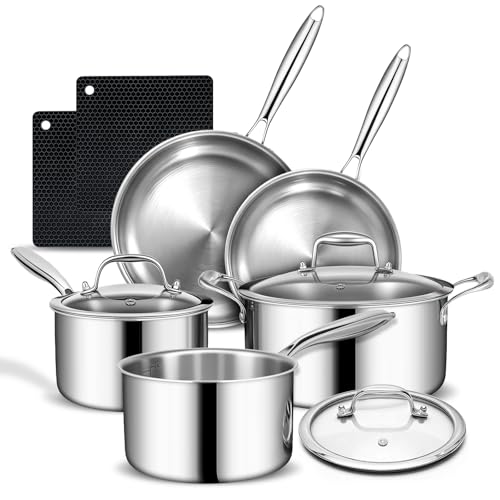
Pros
- Induction-compatible tri-ply construction for even heating
- Pots and pans oven safe up to 500 degrees
- Internal volume markings inside pots for easy measuring
- Stay-cool ergonomic handle design
Cons
- Assembly required for pot and lid handles
- Glass lids are not oven safe

Pros
- Compatible with all stovetops including induction
- Rivetless interior simplifies everyday cleaning
- Oven safe up to 550 degrees Fahrenheit
- Includes matching lids, silicone utensils, and pan protectors

Pros
- Detachable handles enable compact nesting in cabinets
- Tri-ply stainless steel bases work on induction stovetops
- Pan bodies safe in ovens up to 600°F
- Ceramic nonstick interior cleans easily without PFAS
Cons
- Glass lids limited to 350°F in ovens

Pros
- Induction, gas, and electric cooktop compatible
- Oven safe up to 500°F
- Dishwasher safe construction makes cleanup fast
- Aluminum encapsulated base eliminates hot spots

Pros
- Triple-ply aluminum core construction heats evenly
- Oven safe up to 500 degrees Fahrenheit
- Induction cooktop compatible
- Tapered rims ensure drip-free pouring
Cons
- Heavy total set weight of 26 pounds
Buying Guide: Choosing Between Ceramic Cookware vs Stainless Steel
Both materials offer real kitchen utility, but they serve different cooking habits. Understanding how heat transfers, how coatings react to daily use, and how construction influences pan longevity ensures you choose a set suited to your everyday meal prep.
Cooking Surface and Food Release
Ceramic cookware relies on a smooth, mineral-based nonstick layer, commonly derived from silica, which lets eggs, pancakes, and delicate fish release easily with minimal cooking oil. The trade-off is surface fragility. Even reinforced ceramic finishes, like the diamond-infused layer on the GOTHAM STEEL 12 Pc Titanium Ceramic Cookware Set, wear down over time and require gentle use to preserve their release properties.
Stainless steel features a hard, non-porous metal surface without any applied coating. Food will stick if the pan is not properly preheated with cooking oil or fat. However, this stickiness is a feature when building pan sauces and developing deep fond from seared meats. It will not degrade from high heat or develop peeling spots after months of daily use.
Heat Distribution and Metal Cladding
Stainless steel alone is a poor conductor of thermal energy. To solve this, quality cookware incorporates layered cladding or an aluminum core sandwiched between steel sheets. Sets like the CAROTE 18 PCS Stainless Steel Cookware Set and Stainless Steel Cookware Set,Tir-Ply Pots and Pans feature tri-ply construction extending from the base up the sidewalls, which eliminates localized hotspots and cooks food evenly.
Ceramic sets often use a cast or pressed aluminum base, such as the SENSARTE Nonstick Ceramic Cookware Set, which conducts heat swiftly and responds rapidly to burner adjustments. Aluminum heats quickly, but thin bases can warp over intense heat cycles. For heavy boiling tasks or rapid water prep, cooks often lean toward sturdy metal designs like those found in an electric kettles stainless steel guide rather than coated aluminum vessels.
Oven Safe Temperature Limits
If your cooking style involves searing on the cooktop and finishing dishes inside the oven, thermal thresholds matter. Stainless steel pans regularly handle 500 degrees Fahrenheit or higher. Sets like the 3 Ply Stainless Steel Cookware Set and Cuisinart Chef’s Classic 11-Piece Stainless Steel are rated to 500 degrees Fahrenheit, while hybrid pieces like the GreenLife Stainless Steel Nonstick 10 Piece handle up to 600 degrees Fahrenheit for the pan bodies.
Always check lid and handle restrictions. Tempered glass lids and silicone-wrapped parts usually cap out between 350 and 425 degrees Fahrenheit. Bakelite handles, while comfortable on the stove because they remain cool to the touch, will melt under broiler elements. Pure metal handles require oven mitts but offer far greater oven versatility, much like hardware found when choosing between toaster ovens cuisinart designs and compact countertop setups.
Cleaning, Utensils, and Long-Term Maintenance
Ceramic cookware demands non-abrasive care. While models such as the GOTHAM STEEL 20 Pc Ceramic Cookware Set claim scratch resistance against metal utensils, repeated scraping, harsh scour pads, and frequent dishwasher detergents cause nonstick surfaces to lose slickness. Hand-washing with soft sponges is recommended to maintain the mineral coating.
Stainless steel tolerates rugged cleaning. You can freely use metal tongs, whisks, and steel wool without stripping a delicate film. Burnt-on grease or mineral spots can be removed with acidic cleaners or vigorous scrubbing. The trade-off is elbow grease: stainless steel will show burnt oils and water spots, whereas smooth nonstick simply wipes clean after a meal.
Storage Footprint and Kitchen Space
Cookware sets take up substantial cabinet volume. Ceramic pans stacked directly on top of each other risk gouging each other’s coatings, which requires storing them with protective felt pads or hanging them on racks. The GreenLife Stainless Steel Nonstick 10 Piece addresses this directly by incorporating detachable handles and nesting bodies, which GreenLife says saves cabinet space.
Stainless steel pieces stack inside one another without fear of chipping nonstick coatings, making them reliable choices for compact drawer storage alongside microwaves countertop buying guide equipment in tighter kitchens. If storage is at a premium, choose fewer multi-functional vessels over sprawling 18-piece or 20-piece collections.
How We Compared These Products
Our buying guide relies on comparative product research, manufacturer specifications, published material standards, and verified consumer product listing rather than hands-on laboratory testing. We examined material compositions such as tri-ply cladding versus aluminum cores, compared stated stovetop and induction compatibility across all models, evaluated stated oven limits for both bodies and lids, and assessed included components to determine which kits offer genuine kitchen utility.
Which Option Fits Your Kitchen?
Different cooking routines favor different equipment designs. Here is how specific sets align with distinct household priorities:
For Small Kitchens and Tight Storage: The GreenLife Stainless Steel Nonstick 10 Piece is designed specifically for limited shelf space. Its detachable click-on handles and nesting bodies allow the pots and pans to stack securely into shallow drawers or compact RV cabinets without wasting clearance. The tri-ply steel body paired with a ceramic interior combines quick-release cleanup with induction-ready durability.
For High-Heat Searing and Durability: If your priority is longevity and technique-driven cooking, the Cuisinart Stainless Steel Pots and Pans Set delivers classic unlined utility. Its triple-ply construction with an aluminum core distributes heat up the sidewalls, and the uncoated 18/8-style steel cooking surface can handle scorching oven temperatures up to 500 degrees Fahrenheit, acidic tomato sauces, and heavy scrubbing without surface deterioration.
For Low-Fat Cooking and Quick Weeknight Cleanup: The SENSARTE Nonstick Ceramic Cookware Set works well for cooks prioritizing effortless post-meal routines. Its rivet-free ceramic interior prevents food residue from collecting in corners, and eggs or starches release with minimal added butter or oil. The stay-cool handles and included pot protectors help preserve the nonstick coating during daily use.
Frequently Asked Questions
Can I use metal utensils on ceramic cookware?
While some brands, like Gotham Steel and GreenPan, incorporate diamond or titanium reinforcement and claim metal utensil resistance, metal tools can still scratch or micro-chip ceramic surfaces over time. Using wood, silicone, or nylon tools is the safest way to maintain nonstick performance over years of use.
Why does food stick to stainless steel pans?
Food sticks to stainless steel when the pan is not hot enough before adding oil, or when cold food is placed into a dry pan. Preheating the pan before adding oil helps create a thin barrier between the hot metal and delicate proteins.
Are ceramic pans completely free of PFAS and PTFE?
Yes, genuine ceramic nonstick coatings are mineral-based (typically derived from silicon dioxide) and formulated without PTFE, PFAS, PFOA, lead, or cadmium. They contain no fluoropolymer coating, though high heat can still wear down their nonstick release.
Do stainless steel sets work on induction cooktops?
Stainless steel cookware works on induction only if its exterior base contains magnetic steel, such as 430-grade stainless steel. Clad cookware like the 3 Ply Stainless Steel Cookware Set uses magnetic exterior layers specifically so that the pots operate seamlessly on induction burners.
Can you put ceramic and stainless steel cookware in the dishwasher?
Stainless steel is generally dishwasher-safe, though harsh detergents may leave chalky mineral film or water spots. While many ceramic pans are labeled dishwasher-safe, the high heat, abrasive detergents, and spray pressure will gradually wear away nonstick coatings. Hand-washing ceramic vessels ensures a longer usable lifespan.
Which cookware lasts longer: ceramic or stainless steel?
Stainless steel cookware lasts significantly longer. Because it contains no surface coating to chip, peel, or thin out, high-grade stainless steel pots and pans can last decades or even a lifetime. Ceramic nonstick coatings wear over time, and how long they last depends on heat, utensils, and cleaning.
Can ceramic cookware handle high-heat searing?
Ceramic nonstick coatings work best at low to medium heat, and high heat can wear the coating faster. Stainless steel is the better choice for hard searing.
Is stainless steel cookware hard to clean?
Food sticks to stainless steel when the pan is cold or not oiled enough. Deglazing the hot pan with broth, wine, or water loosens cooked-on residue quickly, and baking soda or a stainless steel cleanser handles stubborn stains.




Write Your Review
No reviews yet. Be the first to share your experience!