

Outfitting a kitchen with matched pots and pans solves multiple cooking needs at once, but mismatched cookware often creates cabinet clutter. Many home cooks discover too late that their set includes redundant skillet sizes, lacks induction support, or requires strict handwashing that clashes with their daily routine.
This guide compares durable materials, piece versatility, and care requirements across prominent options to help identify which cookware sets best match your stove type, cabinet dimensions, and meal sizes.

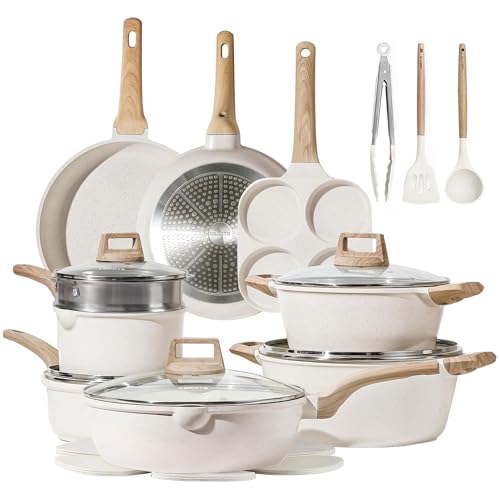
Pros
- Integrated pour spouts facilitate clean liquid draining
- Silicone-rimmed glass lids seal tightly and prevent chipping
- Dishwasher-safe construction streamlines cleanup
- Includes utensils, silicone trivets, and pan protectors
Pros
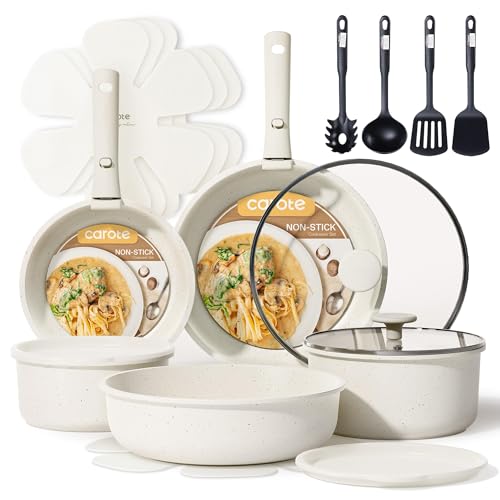
- Compatible with all cooktops including induction
- Lightweight die-cast aluminum construction heats quickly
- Includes four pan protectors plus basic cooking utensils
- Includes 12-month manufacturer warranty from purchase date
Cons
- Hand washing recommended instead of dishwasher use
Pros
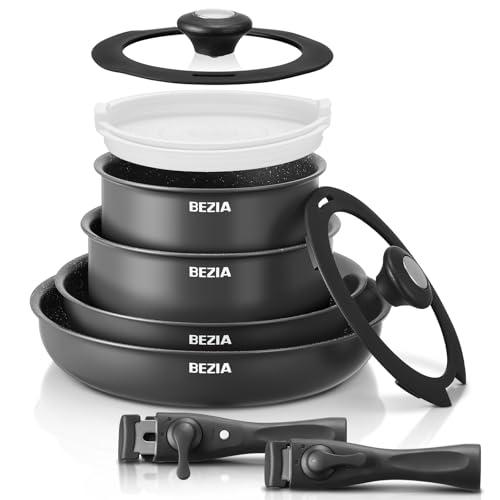
- Removable handles enable space-saving stackable storage
- Vessels transition directly from stovetop to oven
- Includes storage lids for direct refrigeration
- Nonstick surface cleans without heavy scrubbing
Cons
- Only two detachable handles shared across five pans

Pros
- Compatible with induction, gas, electric, and ceramic stoves
- Pre-installed stay-cool Bakelite handles require no assembly
- Comprehensive 31-piece bundle covers cooking and baking needs
- Stackable carbon steel bakeware minimizes cabinet clutter
Cons
- Hand washing required; not dishwasher safe
- Metal utensils and abrasive cleaners damage nonstick coating

Pros
- Dishwasher-safe hard-anodized construction
- Thermo-Spot preheat indicator on frypans
- Oven safe up to 400 degrees Fahrenheit
- Includes specialty griddle and steamer insert
Cons
- Not compatible with induction stovetops
- Lids only oven safe to 350 degrees Fahrenheit

Pros
- Detachable handles enable compact nesting inside small cabinets
- Cookware transfers safely between stovetop, oven, and refrigerator
- Includes dedicated storage lids and felt pan protectors
- Nonstick coating allows quick and effortless post-meal cleanup
Cons
- Only two detachable handles serve five separate cooking vessels

Pros
- Induction, gas, and ceramic stovetop compatible
- Includes protective pan separators for stacked storage
- Glass lids allow easy monitoring while cooking
- Titanium nonstick surface eases food release

Pros
- Removable handles enable compact nesting storage
- Compatible with all stovetops including induction
- PFOA-free nonstick surface cleans easily in dishwasher

Pros
- Induction, gas, and electric cooktop compatible
- Oven safe up to 500°F
- Dishwasher safe construction makes cleanup fast
- Aluminum encapsulated base eliminates hot spots

Pros
- Die-cast aluminum distributes heat rapidly and evenly
- Titanium-reinforced nonstick coating ensures smooth food release
- Silicone-sealed glass lids prevent chipping and lock moisture
- Includes matching utensils and protective pan separators
Cons
- Requires hand washing to prevent base residue
Core Materials and Heat Conduction
Cookware performance depends heavily on the core metal used beneath the cooking surface. Die-cast aluminum and encapsulated aluminum bases spread heat rapidly across the cooking area, which minimizes hot spots during delicate tasks like simmering sauces. In contrast, hard-anodized aluminum undergoes an electrochemical treatment that hardens the exterior metal, making it more resistant to denting and external abrasion.
Stainless steel cookware, such as the Cuisinart Chef’s Classic collection, pairs stainless exterior walls with an internal aluminum core to combine long-term surface durability with thermal distribution. If high-heat searing or metal utensil use is common in your kitchen, uncoated stainless steel handles rough treatment better than coated surfaces. However, aluminum bodies coated with nonstick finishes offer superior food release at low to medium temperatures, requiring less cooking fat.
Coating Types and Surface Upkeep
Cooking surfaces dictate how you prepare food and clean up afterward. Traditional PTFE-based nonstick and titanium-reinforced coatings offer slick surfaces that allow delicate foods like eggs and fish to slide off with minimal oil. Mineral-based ceramic coatings provide an alternative for cooks who prefer chemical-free surface manufacturing, though all nonstick coatings gradually wear out faster than bare stainless steel.
Maintenance needs differ by coating formulation. Many manufacturers specify handwashing with soft sponges and mild detergents to protect surface longevity, even when packaging states the pans are dishwasher safe. Exposure to abrasive dishwashing detergents and high drying temperatures can degrade nonstick properties or cause black residue on exposed aluminum bases over extended cycles.
Cooktop Compatibility and Base Construction
Before purchasing, confirm the base design matches your cooktop. Induction ranges require cookware with a magnetic bottom, typically achieved by bonding a magnetic stainless steel plate to the aluminum vessel. While standard gas and electric coil stoves work with virtually any flat metal base, smooth glass cooktops benefit from flat, warp-resistant bases that maintain steady contact.
Always verify induction claims in the product specifications. While most modern sets with bonded steel plates function across gas, electric, and induction stoves, some collections, including specific hard-anodized lines like the T-Fal Ultimate set, explicitly exclude induction stoves due to non-magnetic base construction.
Handle Configurations and Storage Space
Fixed handles require substantial clearance inside kitchen cabinets and can prevent lids from nesting cleanly. Riveted stainless steel or molded Bakelite handles offer permanent, rigid security during lifting and pouring, but they take up significant shelf volume in small apartment kitchens or recreational vehicles.
Detachable handle systems change this storage equation by allowing vessels to nest directly inside one another like mixing bowls. Sets with click-on handles, such as Carote’s modular systems, free up cabinet room and allow vessels to slide into standard refrigerators with flat storage lids. The trade-off is the need to latch and unlatch handles when moving multiple pans on a crowded stovetop.
Oven Limits and Lid Designs
Oven-safe ratings determine whether you can start a dish on the burner and finish it under the broiler. Solid stainless steel vessels without synthetic coatings can handle high oven temperatures up to 500 degrees Fahrenheit. Nonstick pans and sets equipped with silicone or Bakelite components generally carry lower heat thresholds, frequently limited to 350 to 400 degrees Fahrenheit.
Lid construction also influences cooking control. Tempered glass lids permit visual monitoring of boiling liquids without releasing trapped steam and moisture. Silicone-rimmed glass lids offer additional impact protection along the rim and seat snugly against the vessel edges, while built-in pour spouts simplify draining pasta water without needing a separate colander.
How We Compared These Products
This guide is based on product research, manufacturer technical specifications, material data sheets, and verified customer feedback patterns rather than direct laboratory tests. We analyzed vessel capacities, base compatibility, handle security mechanisms, and manufacturer care requirements across 10 products to help home cooks evaluate functionality against their specific kitchen layouts and cooking styles.
Which Option Fits Your Kitchen?
For compact spaces, dorms, or recreational vehicles where shelf clearance is tightly restricted, a detachable handle configuration minimizes clutter. The CAROTE 19pcs Pots and Pans Set Non Stick stacks neatly by removing handle hardware, allowing the pans to double as refrigerator storage containers using the included plastic lids.
For cooks who prioritize high-heat searing, oven finishing up to 500 degrees Fahrenheit, and surfaces impervious to metal whisks, uncoated stainless steel remains the practical choice. The Cuisinart Chef’s Classic 11-Piece Stainless Steel set features aluminum-encapsulated bases and riveted stainless handles suited for demanding cooking methods without the wear limits of synthetic coatings.
For households outfitting a kitchen from scratch that need both stovetop vessels and oven bakeware in a single package, the Pots and Pans Set Non Stick from Umite Chef provides 31 pieces. It supplies daily skillets, a dedicated square grill pan, silicone tools, and carbon-steel baking pans to cover sweet and savory cooking without purchasing secondary accessory bundles.
Frequently Asked Questions
Can all nonstick cookware sets be washed in the dishwasher?
While several nonstick product listings specify dishwasher compatibility, handwashing remains the safest method for preserving nonstick performance. Harsh automatic detergents, high water temperatures, and hard minerals degrade nonstick surfaces over time and can cause dark oxidation on uncoated aluminum exterior bases.
How do I know if a cookware set will work on an induction cooktop?
Induction stoves function via magnetic fields, meaning the cookware must contain a magnetic material such as iron or magnetic-grade stainless steel. Check the manufacturer specifications for explicit induction compatibility, or test the bottom of an existing pan with a standard refrigerator magnet; if the magnet adheres firmly, the pan works on induction.
What is the difference between ceramic and standard nonstick coatings?
Ceramic coatings are derived from silica or inorganic mineral solutions and are applied without PTFE chemicals. Traditional nonstick coatings rely on fluoropolymer formulations, often reinforced with titanium or granite particles. Both styles release food easily, but traditional coatings generally offer slightly longer wear life under steady home use.
Are detachable handles secure enough for lifting heavy pots?
Modern detachable handle systems use mechanical clamp mechanisms designed to lock firmly onto the pan rim during cooking and lifting. However, they should always be disengaged before placing cookware into a hot oven to avoid damaging the internal release springs, and you must verify the latch is fully locked before carrying hot liquids.
Why do piece counts in cookware sets vary so widely?
Cookware set piece counts include every standalone item packaged in the box, not just the metal vessels. Manufacturers count individual pot lids, silicone utensils, steamer inserts, pan protectors, and plastic storage covers toward the total piece count. Review the itemized manifest rather than the total count to confirm how many actual cooking vessels are included.
Can I use metal spoons and spatulas on coated cookware?
Metal utensils can scratch, chip, or gouge nonstick and ceramic surfaces, leading to premature release failure. It is best to use wooden, silicone, or heat-resistant nylon utensils on any coated pan. Reserve metal turners, whisks, and tongs strictly for uncoated stainless steel or cast iron cookware.

Write Your Review
No reviews yet. Be the first to share your experience!