

A board that is too small crowds your prep, while a thick, heavy block can be awkward to move and store. This best wood cutting board guide compares single boards and multi-size sets, with practical differences in wood, grain construction, juice grooves, and care to help you choose for your kitchen and cooking habits.
Pros
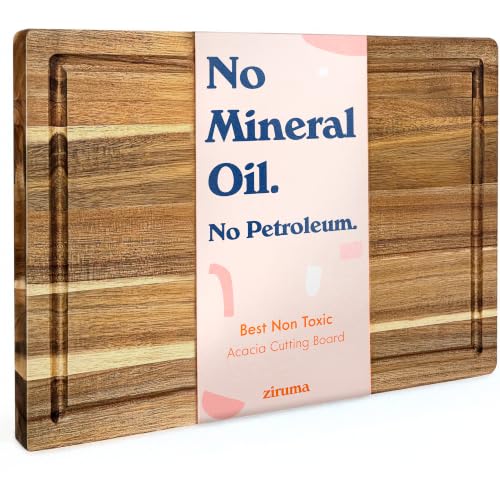
- Solid acacia construction
- FSC-certified wood
- Natural oil and beeswax finish
- Manufacturer-described knife-friendly surface
- 2.9-pound weight
Cons
- Who should skip it: cooks needing a larger cutting area

Pros
- Three useful board sizes for different prep tasks
- Pre-oiled surface arrives ready for use
- Wooden stand keeps boards organized
- Juice groove supports meat carving
- Detachable non-slip rubber feet
Cons
- Three boards require more storage than a single board
- Listing does not provide care instructions
- Who should skip it: Single-board shoppers

Pros
- Thick 1.75-inch end-grain maple construction
- Heavy 10 lb build with non-slip feet
- Juice groove and finger grips support carving
- Made in USA by local woodworkers
Cons
- Hand wash only, never soak or use dishwasher
- Monthly conditioning adds ongoing maintenance
- Skip it if you need a lightweight board
Pros
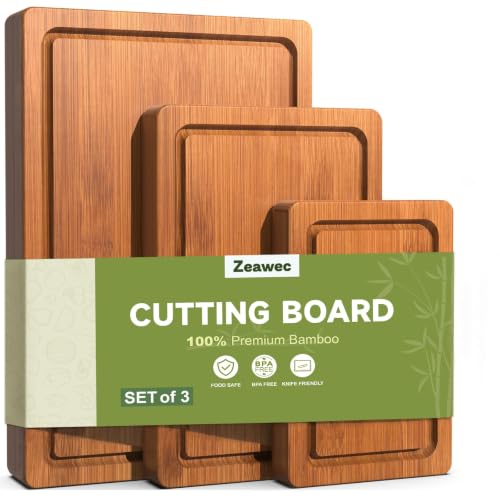
- Three-piece set supports varied prep tasks
- Deep juice grooves contain liquids
- Pre-oiled bamboo surface supports knife care
- Carbonized bamboo resists cracking and splitting
Cons
- Care instructions are not provided in published specifications
- Dishwasher compatibility is not specified
- Skip it if dishwasher compatibility is essential

Pros
- Large 17-by-12-inch cutting surface
- Rubber feet for stability
- Juice groove
- FSC-certified teak
Cons
- Skip it if you need a compact cutting board

Pros
- Three board sizes for different prep tasks
- Reversible surfaces for serving
- Stackable for storage
- Built-in juice grooves
Cons
- Care requirements are not specified
- Who should skip it: buyers requiring stated dishwasher compatibility

Pros
- Three useful board sizes
- Non-slip base
- Rounded edges
- Durable teak construction
- FSC-certified wood sourcing
Cons
- Requires hand washing and occasional oiling
- Who should skip it: cooks needing dishwasher-safe boards

Pros
- Thick 1.7-inch construction
- Reversible cutting and serving design
- Included oil and plate
- End-grain walnut construction
Cons
- Hand washing required
- 6.79-pound weight may feel heavy
- Who should skip it: dishwasher users

Pros
- Knife-friendly end grain surface
- Useful chopping and serving format
- Substantial 4-pound construction
- Individual acacia grain pattern
Cons
- Hand wash only
- Requires regular oiling
- Who should skip it: dishwasher users

Pros
- Acacia wood has distinctive swirling grain patterns
- Built-in cracker well supports charcuterie serving
- 3.5-fluid-ounce groove helps catch juices
- Gift box included
Cons
- Six-pound weight may feel substantial during handling
- Who should skip it: Shoppers wanting a lighter cutting board
How to Choose the Best Wood Cutting Board
Wood type and grain construction
Wood species and grain orientation affect the board’s feel, appearance, and maintenance needs. The options here include acacia, teak, walnut, maple, and bamboo. The listings describe the maple and several teak or acacia options as end grain, while the Sonder Los Angeles board is edge grain. End-grain construction is often chosen for a substantial, knife-conscious chopping surface; edge grain can be a straightforward everyday option. These are design descriptions, not independent performance findings.
If protecting a frequently used knife edge is a priority, compare the end-grain boards, including the maple, walnut, and Ironwood acacia options. If you prefer a multi-board set or a different wood species, compare the acacia and teak sets. Bamboo is not a conventional hardwood board, so consider it separately if you specifically want a solid-wood surface.
Board size, thickness, and weight
A generous work surface gives you room to chop without repeatedly moving ingredients, but it also takes up more counter and cabinet space. The listings specify a 17-inch maple board that weighs 10 lb, a 17-inch teak board, and a 1.7-inch-thick walnut board. Those substantial designs may suit carving or larger prep jobs, but check your counter and storage space before choosing one.
For smaller tasks or more flexible storage, the Deer & Oak and Socisen sets offer three board sizes each. Their smallest boards are listed at 10.2 by 7.1 inches and 10 inches, respectively. Check each set’s full dimensions and the space needed to store all three boards before buying.
Juice grooves and prep tasks
A juice groove can help contain liquid when carving meat or slicing juicy produce, though it reduces the flat cutting area available on that side of the board. The maple, Sonder Los Angeles, and several set listings specify grooves. The Sonder board also has a cracker well intended for serving, while the walnut listing describes a notch and plate for moving chopped ingredients.
Think about what you cut most often. For meat prep or carving, a groove can be useful; for broad vegetable prep, a large uninterrupted surface may matter more. Check whether a groove or serving feature is on the side you expect to use.
Stability and handling
Rubber feet or a non-slip base can help keep a board in place, but feet also make the board less convenient to flip or use on both sides. The maple listing specifies non-slip feet, and the teak listings describe non-slip bases or feet. The Deer & Oak set includes detachable non-slip rubber feet. If you prefer a reversible serving surface, verify which side has grooves or feet and whether the design allows the way you plan to use it.
Cleaning, conditioning, and storage
The listed wooden boards call for hand washing, and some specify occasional oiling or conditioning. The maple board arrives with a mineral-oil finish and its listing recommends monthly conditioning; the walnut board is described as pre-oiled and includes an oil bottle. The Ziruma acacia board instead specifies a beeswax, flaxseed, and lemon-oil finish. Follow the care instructions for the exact board you choose, and do not assume that a finish eliminates the need for maintenance.
Wood boards are not a good fit if you need a dishwasher-safe cutting surface. Allow space for a thick or multi-piece set to dry and store, and consider whether you can comfortably lift a heavy board. For more help matching a prep surface to your knives, see our knife set buying guide.
How We Compared These Products
This comparison is based on the published product listings, including their stated materials, sizes, construction, features, and care directions, along with the available customer feedback data. It is product research rather than a firsthand evaluation, so performance claims in the listings are treated as manufacturer descriptions, not independently verified results.
Which Option Fits Your Kitchen?
For several sizes in one set: Deer & Oak 3-Piece Acacia Cutting Board Set provides three stated sizes, a stand, and detachable non-slip feet. The trade-off is storing multiple boards and the stand. Who should skip it: cooks who want one board and have limited storage.
For a substantial carving surface: Maple End-Grain Cutting Board (Made in USA) is listed as a 17 by 13-inch, 10 lb board with a juice groove and non-slip feet. It requires hand washing and regular conditioning. Who should skip it: anyone prioritizing easy lifting, compact storage, or minimal wood care.
For a budget-minded multi-size set: 3-Piece Deep-Carbonized Bamboo Cutting Board has three sizes and deep juice grooves according to its listing. Bamboo is a different material from the acacia, teak, walnut, and maple boards here, and the listing does not give individual board dimensions. Who should skip it: shoppers who specifically want a solid hardwood board or need dimensions confirmed before purchase.
Other options to compare: Non-Toxic Acacia Wood Cutting Board is listed as 16 by 11 inches and 1 inch thick, but it is a single board rather than a set. Who should skip it: cooks seeking multiple sizes. 3 Pack Teak Cutting Boards for Kitchen Wood Wooden offers three stated sizes and a non-slip base; who should skip it: anyone without room for a set.
Teak Wood Cutting Board for Kitchen Non Slip is a 17-inch board with a non-slip base, but its listed rating is lower than some options. Who should skip it: buyers who want more customer feedback to weigh. ROYAL CRAFT WOOD Wooden Cutting Boards for Kitchen provides three listed sizes and grooves; who should skip it: shoppers who prefer hardwood to bamboo.
American Walnut Wood Cutting Board is an extra-thick end-grain board with a notch and plate described for transferring food. Who should skip it: cooks who need a light, compact board. Ironwood Acacia Wood Charleston 14" Square End has a 14-inch-square end-grain surface; who should skip it: anyone needing a longer rectangular board. Sonder Los Angeles Winsome Acacia Wood Cutting combines a juice groove and cracker well; who should skip it: cooks who would rather have an uninterrupted work surface.
Frequently Asked Questions
Can these wood cutting boards go in the dishwasher?
The published listings specify hand washing for several boards and do not establish dishwasher compatibility for the group. Use the care instructions for your specific model; avoid assuming a wood board is dishwasher-safe.
What is the difference between end grain and edge grain?
End-grain boards are assembled with the wood fibers oriented toward the cutting surface, while edge-grain boards present the side of the wood fibers. The product listings describe end grain as knife-friendly, but construction alone does not establish how a particular board will perform over time.
Is bamboo the same as a hardwood cutting board?
No. Bamboo is a grass, not a hardwood. The bamboo options in this comparison are described as carbonized bamboo boards, so choose them if that material and set format fit your needs rather than treating them as interchangeable with the listed maple, walnut, teak, or acacia boards.
Should I choose a board with a juice groove?
A groove can help catch liquid during carving or slicing juicy ingredients. It also takes up part of the surface, so a broad flat area may be more useful for general chopping. Match the feature to the foods you prepare most often.
Do wood cutting boards need oil?
Some listings recommend periodic oiling or conditioning, and some boards arrive pre-oiled. Follow the specific care directions and use a product intended for cutting boards. The listed finishes vary, so do not assume every board needs the same treatment.
Are multi-board sets useful in a small kitchen?
Sets let you choose a board size for different tasks, but all pieces need somewhere to dry and store. If cabinet space is limited, measure the storage area and check the set’s dimensions before choosing it; a single board may be simpler to keep accessible.


Write Your Review
No reviews yet. Be the first to share your experience!