

A pan that is too large can be awkward to store and maneuver, while a small one may not leave enough room for a holiday roast. This best roasting pan guide compares sizes, materials, racks, stovetop compatibility, oven limits, and care details to help you match a pan to the meals you actually cook.
Think about cleanup and gravy-making as well as the roast itself. If you are also choosing equipment for other cooking tasks, our guides to meat thermometers and carbon steel pans cover two useful kitchen decisions.

Pros
- Includes a V-shaped rack
- Nonstick coating
- Dishwasher safe
- Oven safe to 464°F
Cons
- Not broiler safe
- Not for stovetop or open-flame use
- Who should skip it: cooks needing broiler or stovetop use


Pros
- Includes a U-shaped roasting rack
- Nonstick surface for easier food release
- Oven safe to 450°F
- Wide handles for gripping
Cons
- Care requirements are not specified
- Who should skip it: cooks requiring confirmed dishwasher-safe care

Pros
- Tri-ply construction extends to the rim
- Works on induction and other listed cooktops
- Includes a stainless steel roasting rack
- Oven safe up to 500°F
Cons
- At 10 lb, it may be cumbersome to handle
- Hand-washing helps preserve the polish
- Skip it if you need a lightweight, compact roaster

Pros
- Rack included for airflow around food
- Induction-compatible
- Dishwasher-friendly
- Oven-safe up to 900°F
Cons
- Listed weight is 5 pounds
- Who should skip it: cooks needing a larger roasting pan


Pros
- Covered design for roasting or braising
- Induction-compatible
- Dishwasher-safe per listing
- Sturdy loop handles
Cons
- Not suitable for microwave use
- Who should skip it: cooks needing microwave-safe cookware

Pros
- Includes a nonstick rack
- Induction-compatible
- Oven safe up to 500°F
- Dishwasher safe
Cons
- Nonstick coating calls for gentle utensils and cleaning
- Skip it if you prefer uncoated cookware

Pros
- U-shaped rack keeps meat above drippings
- Angled handles preserve pan cooking space
- Nonstick coating for easier food release
Cons
- Listed dimensions conflict with the 17 x 13-inch title
- Who should skip it: cooks needing confirmed oven fit
How to Choose the Best Roasting Pan
Match the pan dimensions to your oven and meals
Check a pan’s outside dimensions against your oven, including room to grip its handles. The listed options range from the 14-by-10-inch HexClad to larger designs such as the 17-by-13-inch Circulon and EWFEN. A larger footprint can suit bigger roasts or vegetables, but it also takes more shelf and cabinet space. The Glad listing gives interior and exterior measurements, a helpful distinction when checking fit. Measure your oven rack and storage area before choosing.
Choose a construction that suits how you cook
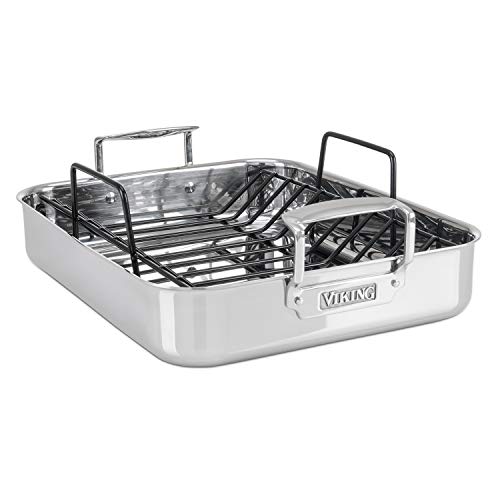
Stainless steel and clad pans suit cooks who want a nonreactive surface and may want to make a pan sauce. Cuisinart, Made In, and Viking specify stainless-clad construction; Cuisinart and Viking also list aluminum cores for heat distribution. Nonstick pans, including the Glad, Farberware, Circulon, All-Clad, and EWFEN options, emphasize food release and cleanup. Their coatings have care limits, so follow each maker’s instructions instead of assuming all nonstick pans handle utensils or high heat alike.
Consider the rack and whether you need a lid
An elevated rack keeps food above drippings and can allow air to circulate around it. Rack shapes vary: the Glad listing specifies a V-shaped rack, while Circulon and EWFEN list U-shaped designs. A rack can make a large roast easier to lift, but it adds another part to clean and store. The VANKUTL is the listed covered oval design, with a lid intended to retain heat and moisture. Choose a covered pan if that design fits your cooking plans, and check its dimensions before buying.
Verify stovetop compatibility and oven limits
Stovetop compatibility matters if you want to use the roasting pan to make gravy or reduce drippings. Cuisinart, HexClad, All-Clad, Viking, and VANKUTL list induction compatibility, but do not assume that every stainless or steel pan works on induction. Check the individual listing for your cooktop type. Oven limits also vary: listed limits include 450°F for Circulon, 500°F for Cuisinart and All-Clad, and 600°F for Viking and VANKUTL. Follow the limit for the pan and any separate lid or rack.
Plan for cleaning, handling, and storage
Dishwasher compatibility can reduce cleanup, but manufacturer care guidance still matters. Glad, VANKUTL, and All-Clad list dishwasher-safe designs; Cuisinart advises hand-washing to help preserve its polish. Nonstick surfaces may need gentler utensils or cleaning materials, depending on the model. Wide or riveted handles can be useful when lifting a loaded pan, but measure the total width and consider how you will grip it with oven mitts. A removable rack also needs its own storage space.
How We Compared These Products
This comparison draws on the published product listings, including stated construction, dimensions, racks, compatibility, oven limits, and care directions. We also considered the customer feedback information supplied, but it does not establish a recurring experience or independently verify performance. The recommendations are based on product research, not firsthand cooking or measurement.
Which Option Fits Your Kitchen?
For a smaller footprint: The HexClad Hybrid 14 x 10 Inch Rectangular Nonstick is the compact choice among these listed rectangular pans, with a rack and stated compatibility with induction and other home cooktops. Its oven limit is unusually high as specified in the listing, but check that the pan’s 14-by-10-inch dimensions suit the roast you plan to cook. Skip it if you need a larger roasting surface or prefer a simpler, lower-cost design.
For stainless construction and sauce-making: The Cuisinart MultiClad Pro 16" Stainless Roasting Pan has tri-ply construction, a stainless rack, and a nonreactive cooking surface; its listing also specifies induction compatibility and an oven limit of 500°F. It is a substantial investment compared with the nonstick choices, and Cuisinart recommends hand-washing to maintain the polish. Skip it if nonstick release and the simplest cleanup are your main priorities.
For a covered roast: The 16 Inch Roasting Pan with Lid has an enamel-coated carbon steel body, a lid, and stated induction compatibility. The lid makes it a different option from the open pans with racks, so consider whether covered roasting or braising is useful for your meals. Skip it if you specifically want an elevated rack for roasting above drippings.
Frequently Asked Questions
Can I use a roasting pan on an induction cooktop?
Only if the specific pan is listed as induction-compatible. Cuisinart, HexClad, All-Clad, Viking, and VANKUTL state induction compatibility. Verify the product listing for any model you are considering.
What size roasting pan should I choose?
Start with the largest roast you usually prepare, then check both the pan’s interior and its outside dimensions against your oven and storage space. A listing’s stated bird capacity can help, but confirm the actual measurements rather than relying on a size label alone.
Does a roasting pan rack matter?
A rack holds food above the pan bottom, allowing drippings to collect below. Rack shapes differ, and the published listings describe V-shaped, U-shaped, and flat rack designs. A rack is useful if that setup suits your roast, but it adds another item to clean and store.
Are stainless steel roasting pans easier to clean than nonstick?
Not necessarily. Nonstick coatings are marketed for easier food release, while stainless steel may need more attention after roasting. Stainless can be useful for deglazing and making sauces, but care differs: Cuisinart recommends hand-washing to help maintain its polish.
Can I use a roasting pan to make gravy on the stovetop?
That depends on the pan’s cooktop compatibility. Check its listing before placing it on a burner, particularly for induction. A nonreactive stainless cooking surface, as specified for Cuisinart and Viking, can be suitable for reducing pan liquids, subject to the manufacturer’s use instructions.
Can I put a roasting pan in the dishwasher?
Follow the care instructions for the exact model. Several listings specify dishwasher-safe designs, while Cuisinart recommends hand-washing to preserve the finish. A dishwasher-safe claim does not remove other limits, such as restrictions on abrasive cleaners or metal utensils for particular nonstick pans.


Write Your Review
No reviews yet. Be the first to share your experience!