

Induction cooktops need magnetic base contact. Standard aluminum pans fail on induction surfaces without magnetic steel integration. Mismatched pan bases cause buzzing, slow heating, or burner shutoff.
Guide compares base construction, heat response, and surface durability across 10 options. Details help match cooking habits with right cookware set for induction.
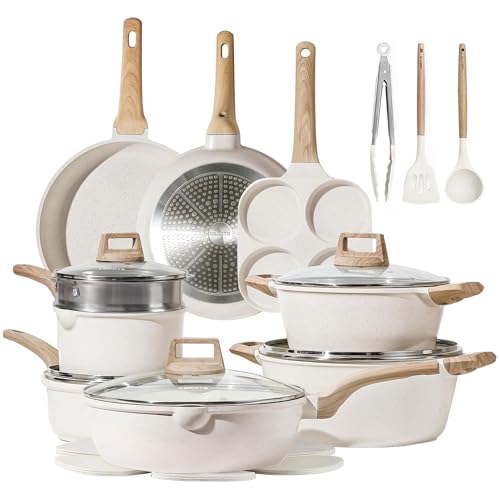
Pros
- Compatible with all cooktops including induction
- Lightweight die-cast aluminum construction heats quickly
- Includes four pan protectors plus basic cooking utensils
- Includes 12-month manufacturer warranty from purchase date
Cons
- Hand washing recommended instead of dishwasher use

Pros
- Compatible with induction, gas, electric, and ceramic stoves
- Pre-installed stay-cool Bakelite handles require no assembly
- Comprehensive 31-piece bundle covers cooking and baking needs
- Stackable carbon steel bakeware minimizes cabinet clutter
Cons
- Hand washing required; not dishwasher safe
- Metal utensils and abrasive cleaners damage nonstick coating

Pros
- Induction-compatible edge-to-edge steel base
- Dishwasher-safe nonstick construction
- Cast stainless handles with silicone grip
- Integrated pour spouts and straining lid
Cons
- Lid oven safety capped at 350 degrees Fahrenheit
- Pan oven safety limited to 400 degrees Fahrenheit

Pros
- Induction, gas, and ceramic stovetop compatible
- Includes protective pan separators for stacked storage
- Glass lids allow easy monitoring while cooking
- Titanium nonstick surface eases food release

Pros
- Induction, gas, and electric cooktop compatible
- Oven safe up to 500°F
- Dishwasher safe construction makes cleanup fast
- Aluminum encapsulated base eliminates hot spots

Pros
- Lab-tested coating free of 106 target PFAS compounds
- Comprehensive 12-piece set covers small and large meals
- Lightweight forged construction enables easy everyday handling
- High 9H surface hardness rating resists abrasion

Pros
- Die-cast aluminum distributes heat rapidly and evenly
- Titanium-reinforced nonstick coating ensures smooth food release
- Silicone-sealed glass lids prevent chipping and lock moisture
- Includes matching utensils and protective pan separators
Cons
- Requires hand washing to prevent base residue

Pros
- Broad 26-piece collection covers diverse cooking tasks
- Silicone-sealed glass lids prevent edge chipping
- Includes storage protectors to safeguard nonstick finish
- Twelve-month manufacturer warranty included
Cons
- Hand washing strongly recommended by manufacturer
- Heavy 27-pound total package weight

Pros
- Triple-ply aluminum core construction heats evenly
- Oven safe up to 500 degrees Fahrenheit
- Induction cooktop compatible
- Tapered rims ensure drip-free pouring
Cons
- Heavy total set weight of 26 pounds
Buying Guide for Cookware Set for Induction Selection
Base Construction and Magnetic Contact
Induction burners generate electromagnetic field. Cookware must contain ferrous metal to create heat. Stamped aluminum bodies need bonded stainless steel base plates. Narrow base plates cause uneven heating on larger induction rings. Edge-to-edge magnetic plates ensure full burner engagement and reduce hot spots.
Heat Distribution: Clad vs Disc-Bottom Construction
Tri-ply stainless cookware sandwiches aluminum core between steel layers across base and sidewalls. Full cladding maintains uniform temperatures during reduction sauces and braises. Disc-bottom pans restrict aluminum layer to bottom surface. Disc bases boil water fast but leave sidewalls cooler, causing ring scorch if heat setting climbs too high.
Surface Types: Stainless Steel vs Coated Nonstick
Bare stainless steel handles high-heat searing, deglazing, and oven broiling. Metal requires fat control and temperature regulation to prevent sticking. Nonstick coatings release eggs and starch easily with minimal oil. Nonstick surfaces degrade under high stovetop heat. Induction heats cookware fast, so dry preheating coated pans damages nonstick layers rapidly.
Handle Materials and Oven Limits
Handle composition dictates oven versatility. Cast stainless steel handles withstand oven temperatures up to 500°F or higher. Bakelite handles stay cool on stovetops without hot pads, but cannot tolerate high oven heat. Tempered glass lids typically cap heat tolerance between 350°F and 425°F. Check separate ratings for vessels, lids, and handles before finishing stovetop dishes in oven.
Pan Flatness and Weight Distribution
Induction sensors require continuous flat contact with glass cooktops. Thin pan bases warp under thermal shock when rinsed hot, breaking magnetic connection. Heavy die-cast aluminum and thick tri-ply bases resist warping. Extremely heavy pans risk scratching glass cooktop surfaces if dragged across burner zones.
How We Compared These Products
Comparison relies on published manufacturer specifications, listed materials, layer construction, base plate dimensions, and verified buyer feedback. Evaluation focuses on magnetic compatibility, oven heat ratings, piece utility, and care requirements. Guide reflects independent product analysis without firsthand laboratory testing.
Which Option Fits Your Kitchen?
For high-heat searing, deglazing, and lifelong durability, select Cuisinart Stainless Steel Pots and Pans Set. Triple-ply stainless construction with aluminum core distributes heat up sidewalls. 500°F oven rating allows seamless stovetop-to-oven braising without coating degradation concerns.
For searing capability paired with easy release, choose Blue Diamond Hybrid 12 Piece Stainless Steel. Tri-ply steel base delivers induction response. Etched surface shields nonstick ceramic matrix, enabling 850°F pan heat tolerance and metal utensil clearance.
For low-oil cooking and easy cleanup, consider Circulon A1 Series Induction Pots and Pans. Edge-to-edge steel base ensures direct induction transfer. ScratchDefense nonstick coating supports dishwasher cleaning, while straining lids simplify everyday prep.
Frequently Asked Questions
How do you test if existing cookware works on induction?
Place refrigerator magnet against pan bottom. Magnet sticks firmly means pan contains ferrous metal and activates induction cooktop. Weak or sliding hold means poor magnetic contact and erratic heating. Complete lack of attraction confirms cookware incompatible with induction.
Why does induction cookware buzz during cooking?
Buzzing stems from high-frequency magnetic fields vibrating bonded metal layers. Loose base plates, multi-ply claddings under high power settings, and light pans vibrate against glass tops. Lowering power setting or switching to heavier, solidly bonded cookware reduces vibration noise.
Can aluminum pans work on induction cooktops?
Raw aluminum lacks magnetic properties and fails on induction cooktops. Aluminum cookware functions on induction only when built with bonded magnetic stainless steel bottom plate. Plate captures electromagnetic energy and transfers conductive heat to aluminum interior.
Does pan base size need to match induction burner size?
Pan base diameter should closely match burner circle. Burner coils do not activate if pan base is significantly smaller than ring sensor. Undersized cookware leaves outer edges unheated, whereas oversized cookware causes slow, centered-only boiling.
Why do induction nonstick pans wear out faster than stainless steel?
Induction stoves deliver energy instantly with zero warm-up lag. Rapid temperature spikes overheat PTFE and ceramic coatings past safe thermal limits before cooks notice. Stainless steel handles rapid temperature rises without chemical breakdown, while nonstick requires strict low-to-medium heat settings.


Write Your Review
No reviews yet. Be the first to share your experience!