

Picking the wrong Dutch oven capacity causes immediate kitchen friction. A vessel that is too small leads to boiled meat instead of a deep sear, while an oversized pot strains cabinet space and weighs too much when full of liquid. Choosing between common Dutch ovens sizes requires balancing typical recipe batch volumes against your physical stovetop and storage limits.
Capacity ratings measure total volume to the brim rather than practical working space. In real cooking, leaving room below the rim prevents messy boil-overs during long simmers and gives crusty artisan loaves space to expand. This guide highlights key Dutch ovens sizes so you can select a footprint and volume tailored to your household cooking habits.

Pros
- Oven safe up to 500°F
- Self-basting condensation nodes inside lid
- Enamel finish resist acidic food without seasoning
- Induction compatible cast iron construction
Cons
- Requires hand washing with mild soap
- Heavy 12.5-pound weight require deliberate lifting

Pros
- Oven-safe up to 500 degrees Fahrenheit
- Compatible with induction, gas, electric, and ceramic cooktops
- Lid condensation nodes redistribute moisture onto cooking food
- Includes pair of thick cotton oven mitts
Cons
- Requires 45 minutes natural cooling before cleaning
- Preheating restricted to medium-low heat settings

Pros
- Oven safe up to 500 degrees Fahrenheit
- Enamel finish eliminates regular seasoning requirements
- Generous 6.4-quart capacity for batch cooking
- Cast iron retains heat evenly for slow cooking
Cons
- Heavy 14.2-pound weight before adding food

Pros
- Compatible with induction and standard stovetops
- Oven safe up to 500 degrees Fahrenheit
- Self-basting lid helps retain cooking moisture
- Enamel coating requires no initial seasoning

Pros
- Oven-safe up to 500°F across all cooktops
- Ready to use without initial seasoning
- Light interior enamel simplifies monitoring food
- Tight lid circulates steam and traps moisture
Cons
- Heavy empty weight at over 13 pounds
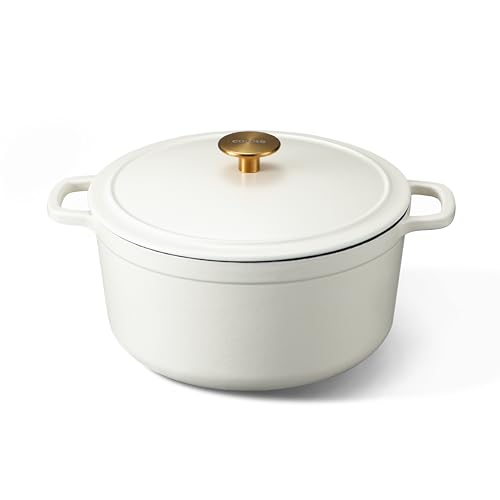
Pros
- Oven-safe up to 500 degrees Fahrenheit
- Compatible with all stovetop types
- Lid nodes direct condensation back into food
- Enamel coating requires no pre-seasoning
Cons
- Heavy empty weight exceeds 13 pounds
- Must cool naturally before washing to protect enamel

Pros
- Oven-safe up to 500 degrees Fahrenheit
- Works on induction, gas, electric, and ceramic stovetops
- Interior lid nodes redistribute moisture during cooking
- Wide stainless steel handles include cotton potholders
Cons
- Requires 45-minute cooling period before cleaning to prevent cracking
- Preheating limited to medium-low heat to protect enamel

Pros
- Oven safe up to 500 degrees Fahrenheit
- Six-quart capacity suits four to six servings
- Heavy-duty cast iron retains heat evenly
- Smooth enamel surface needs no seasoning
Cons
- Heavy 13-pound build requires careful lifting
- Hand wash only without citrus cleaners
- Incompatible with metal cooking utensils

Pros
- Bakes two separate mini loaves simultaneously
- Smooth enameled cast iron requires zero seasoning
- Safe on all cooktops up to 500 degrees
- Comes with two rattan proofing baskets and potholders
Cons
- Small wells limit bake size to single-serving loaves
- Demands full cooling before washing to stop thermal shock

Pros
- Oven-safe up to 500 degrees Fahrenheit
- Compatible with induction cooktops
- Moisture-distributing lid nodes prevent dry food
- Includes thick cotton potholders
Cons
- Heavy 12.7-pound build before adding food
Buying Guide: Matching Dutch Ovens Sizes to Your Kitchen
Working Volume Versus Advertised Capacity
Manufacturers measure liquid capacity right up to the rim of the pot. A five-quart model will realistically hold three to four quarts of usable stew or stock before sloshing becomes a hazard. If you regularly cook large cuts like bone-in pork shoulders or full birds, stepping up to the 7.25-quart range ensures liquids stay below the rim during an active simmer.
Stovetop Footprint and Burner Alignment
Base diameter directly impacts heat transfer across different heat sources. Thick cast iron distributes heat slowly and evenly, but a broad base placed on a small electric coil or induction element can cause outer edge cooler zones during preheating. Aligning base diameter with your cooktop burner prevents uneven browning during initial sear steps.
Standard circular profiles fit typical burner layouts cleanly, allowing secondary cookware to sit nearby on crowded cooktops. If your kitchen utilizes alternative gear for everyday tasks, such as toaster ovens best for daily meals or dedicated multi-cookers, balance your stove footprint to avoid crowding primary workspace.
Total Weight and Handling Safety
Cast iron is inherently dense, and enamel cookware gets substantially heavier when loaded with liquids and dense roasts. A six-quart or seven-quart vessel full of braising broth can exceed fifteen pounds. Look for wide, looped side handles that accommodate bulky heat-resistant mitts safely when transferring the pot between stovetop, oven racks, and the counter.
Lid Interior Design and Moisture Retention
Lid fit determines how much steam escapes during low-and-slow cooking sessions. Flat lids with inner raised nodes, found on several compact and medium models, catch rising vapor and drop it across the surface of the food. Smooth, tight-fitting domed lids create an ambient steam cycle that preserves braising liquid over four-to-six-hour baking intervals without drying out edges.
Bread Baking Shapes and Mini Sizes
Loaf geometry depends closely on pot diameter and vertical depth. A round 5.5-quart Dutch oven provides an enclosed steam chamber that supports high oven spring for standard sourdough boules up to 500 degrees Fahrenheit. Conversely, specialty dual-compartment designs offer mini individual chambers suited for simultaneous small loaves without wasting oven energy.
When outfitting compact apartment counters alongside microwaves countertop buying guide for small kitchens models, small-batch cookware reduces storage footprints. Smaller bread vessels bake single portions efficiently without hogging high-clearance pantry shelving.
How We Compared These Products
This comparison is based on technical specifications, advertised capacities, materials, and customer feedback from verified online product listings. We did not conduct firsthand lab testing or hands-on kitchen cooking trials. Our evaluation analyzes published vessel dimensions, lid designs, manufacturer maximum temperature ratings, and stated handle styles to help you find the correct footprint for your kitchen setup.
Which Option Fits Your Kitchen?
For home cooks preparing large batches, whole poultry, or entertaining guests, high-capacity models offer the required headspace. The Le Creuset Enameled Cast Iron Round Dutch Oven delivers a 7.25-quart volume and wide surface area, making it well-suited for larger recipes where reducing splatters and avoiding boil-overs is critical.
For everyday family dinners and artisan bread baking, mid-sized vessels strike the best practical balance between internal capacity and manageable weight. The Mueller DuraCast 6 Quart Enameled Cast Iron Dutch and the Overmont Enameled Cast Iron Dutch Oven provide 5.5 to 6 quarts of space, self-basting lid nodes, and 500-degree heat limits for routine family meals.
For solo bakers, couples, or small-portion experiments, oversized pots waste cabinet space. The Dutch Oven for Sourdough Bread Baking uses twin 6.3-inch round baking chambers paired with dedicated 5-inch banneton baskets, allowing two mini loaves to bake simultaneously without requiring large batch commitments.
Frequently Asked Questions
What is the most versatile Dutch oven size for everyday cooking?
A 5.5-quart to 6-quart Dutch oven serves as the standard baseline for most home kitchens. This capacity comfortably fits a 4-to-5-pound whole chicken, holds four to six servings of stew, and accommodates standard 500-gram flour sourdough recipes while remaining manageable to clean in a standard sink.
Do smaller Dutch ovens cook differently than large ones?
Smaller Dutch ovens, such as 2-quart to 3-quart models or dual mini pots, heat through faster and retain less overall thermal mass than large vessels. They require closer heat monitoring on the stove to avoid scorching, but they trap steam effectively around small dough portions for improved crust development.
Can I use an enameled Dutch oven on an induction stove?
Yes, cast iron is naturally ferromagnetic, making enameled Dutch ovens compatible with induction cooktops. Ensure the base diameter aligns reasonably with the induction ring so the pot heats uniformly across the entire bottom surface without central hot spots.
How do Dutch ovens sizes affect kitchen storage?
Dutch ovens with 6-quart or 7-quart capacities feature wide circumferences and extended handles that can measure 12 to 14 inches across. Storing them requires deep lower cabinet shelves capable of supporting 10 to 15 pounds, or sufficient counter space if left out permanently.
Why is oven temperature rating important for bread baking?
Artisan bread recipes often call for preheating the pot between 450 and 500 degrees Fahrenheit to generate crust blistering. Verify that both the cast iron body and the lid knob carry a minimum 500-degree rating before using it for high-heat sourdough techniques.
How do I prevent enamel damage when cooking and cleaning?
Always allow hot enameled cast iron to cool naturally to room temperature before adding wash water, as thermal shock can crack the glass coating. Avoid metal utensils and abrasive scouring pads, opting instead for wooden spoons and warm, soapy water with a non-scratch sponge.


Write Your Review
No reviews yet. Be the first to share your experience!