

Ceramic nonstick coatings offer an appealing alternative to traditional nonstick surfaces, particularly for cooks seeking cookware manufactured without PFAS, PTFE, PFOA, or lead. Finding the right set, however, involves navigating notable trade-offs between storage convenience, cooktop compatibility, and long-term surface care.
This guide evaluates 6 different options across the nonstick cookware category. We assess how handle construction, exterior metals, and piece selections impact daily meal preparation, cabinet organization, and routine cleanup so you can invest in the set that best fits your kitchen layout.

Pros
- Detachable handles enable compact nesting
- Compatible with induction, gas, and ceramic cooktops
- PFOA-free nonstick coating ease cleaning

Pros
- Die-cast aluminum build resists daily kitchen wear
- Silicone lids create airtight seal trapping steam
- Coating manufactured without PFOA or PFOS
- Includes four protective pads for nested storage
Cons
- Hand washing recommended over automatic dishwashing

Pros
- Even heat base reduces hot spots
- Thermo-Spot preheat indicator signals ready pan
- Pans oven safe up to 400 degrees
- Silicone-wrapped handles stay secure during handling
Cons
- Not compatible with induction stovetops
- Hand wash recommended for cleaning
- Lids heat-limited to 350 degrees Fahrenheit

Pros
- Works on induction and all standard cooktops
- Coating free of PTFE, PFOA, PFAS, and lead
- Thick 4.8mm base heats quickly and evenly
- Stay-cool Bakelite handles provide comfortable grip
Cons
- Hand washing recommended to protect nonstick surface
Pros
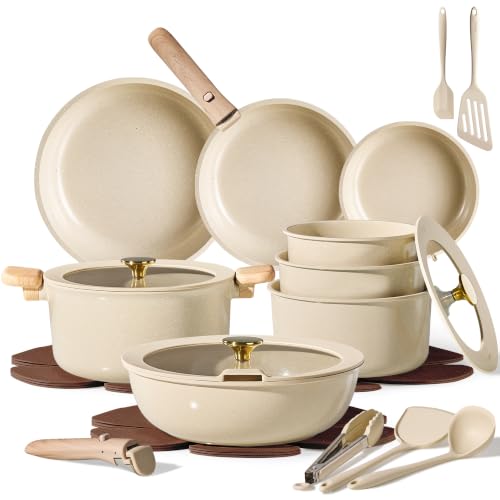
- Detachable handles save significant storage space
- Works on induction, gas, electric, and ceramic stovetops
- Ceramic nonstick surface cleans by hand or dishwasher
- Includes protective pan separators to prevent stacking scratches
Cons
- Only two detachable handles shared across eight vessels

Pros
- Integrated pour spouts facilitate clean liquid draining
- Silicone-rimmed glass lids seal tightly and prevent chipping
- Dishwasher-safe construction streamlines cleanup
- Includes utensils, silicone trivets, and pan protectors
Buying Guide for Nonstick Cookware Ceramic Sets
Handle Design: Fixed vs Removable
Handle architecture fundamentally shapes how you store and handle your cookware. Traditional fixed handles, like the stay-cool Bakelite grips or riveted silicone designs, provide permanent stability and familiar ergonomics when tilting pans to toss vegetables or pour sauces. However, long rigid handles demand substantial cabinet and drawer space.
Sets with detachable handles allow pots and pans to nest tightly within each other, reducing shelf footprint dramatically. The trade-off lies in operating mechanics. You must ensure the locking latch is completely engaged before lifting full vessels of hot liquids. Detachable systems excel in compact kitchens and campers, while fixed handles remain the standard for continuous, high-volume stovetop maneuvering.
Base Construction and Induction Readiness
Ceramic nonstick pans typically use aluminum cores because aluminum conducts heat rapidly and evenly without excess weight. Die-cast aluminum resists warping from moderate heat swings, but raw aluminum does not naturally interact with magnetic induction burners.
To work on induction cooktops, manufacturers bond a magnetic stainless steel plate to the base. If you cook on induction, verify that the pan explicitly includes an induction-ready plate. Some traditional hard-anodized collections deliver exceptional heat distribution on gas and electric coils but exclude magnetic bases entirely. Selecting the wrong base material will prevent induction burners from detecting the cookware.
Lid Features and Moisture Retention
Cookware lids serve distinct functions depending on whether you simmer braises, boil grains, or monitor pan frying. Tempered glass lids let you check cooking progress without lifting the cover and releasing steam. When shopping, examine the lid border and venting.
Silicone-rimmed glass lids create a snug seal that retains moisture, cushions the glass against the pan edge, and reduces rattling during active boiling. Certain lids also integrate straining holes designed to align with built-in pour spouts on the pan body. While integrated pour spouts speed up draining pasta or degreasing browned meats, loose-fitting lids can allow too much steam evaporation during slow reduction cooking.
Surface Care and Longevity
Mineral-based ceramic nonstick coatings release delicate foods like eggs, tofu, and fish with minimal cooking oil. That slick property depends on preserving the integrity of the ceramic gel layer. High heat, abrasive scrubbing pads, and harsh machine detergents can degrade the surface prematurely.
While many ceramic collections state dishwasher compatibility, gentle hand washing with a soft sponge and warm water preserves the release properties significantly longer. Cooks who frequently rely on searing temperatures or metal tools may want to complement their kitchen with stainless steel cookware, reserving ceramic surfaces specifically for moderate-heat cooking and easy food release.
Pan Proportions and Set Composition
Piece counts in large cookware boxes often include accessories such as felt pan protectors, ladles, spatulas, and universal lids. A 21-piece or 25-piece package does not mean you receive 20 separate cooking vessels. Review the actual pot and pan dimensions before purchasing.
Consider whether the set includes the specific tools you use daily. If you prepare quick breakfasts, an 8-inch or 9.5-inch skillet is ideal. For family batch cooking, look for a deep saute pan with at least a 4-quart or 5-quart volume and a dedicated stockpot. Balancing vessel depth against the included utensil count ensures your investment goes toward active cooking surface rather than surplus tools.
How We Compared These Products
Our analysis relies on detailed manufacturer specifications, listed material compositions, dimensional capacities, and verified consumer experiences rather than hands-on testing. We examined base metal construction, declared stovetop compatibility, oven temperature ratings, handle attachment mechanisms, and included accessories across 6 ceramic cookware sets. By cross-referencing functional design traits against everyday kitchen demands, we identified how each set performs across space-constrained cupboards, variable cooktops, and diverse cooking tasks.
Which Option Fits Your Kitchen?
If you face limited cabinet capacity, live in an apartment, or cook inside an RV, the CAROTE 25pcs Ceramic Cookware Set solves storage constraints. Its stackable body profile and removable handle system save significant vertical space in cabinets while providing diverse vessel sizes ranging from small saucepans to a 5.5-quart stockpot.
For cooks who use traditional gas or electric ranges and prefer rugged exteriors with fixed ergonomic grips, the T-Fal Ultimate Hard Anodized 12-Piece Ceramic offers heavy-duty durability. Its hard-anodized exterior resists kitchen bumps, the built-in heat indicator helps avoid overheating the pan, and the riveted silicone handles provide reassuring stability, though it cannot be used on induction surfaces.
If you cook on an induction range and prefer convenient one-pot preparation with minimal cleanup steps, the CAROTE 21pcs Ceramic Cookware Set delivers practical utility. The inclusion of integrated pour spouts, silicone-sealed glass lids, and a dedicated steamer insert makes draining liquids and monitoring meal prep straightforward without pulling out separate colanders.
Frequently Asked Questions
Can ceramic nonstick cookware work on induction stoves?
Ceramic cookware works on induction burners only when the aluminum body incorporates a bonded magnetic steel base plate. Sets with pure aluminum or hard-anodized exteriors without this plate will not heat on induction. Always verify the manufacturer indicates induction compatibility before purchasing.
What utensils should be used on ceramic nonstick pans?
Wooden, silicone, and heat-resistant nylon utensils are best suited for ceramic coatings. Metal spoons, whisks, and spatulas can scratch or micro-fracture the mineral surface, causing food to stick prematurely and diminishing the pan life.
How do you clean ceramic nonstick pans to preserve the coating?
Let the pan cool completely before washing to avoid thermal shock, which can warp the metal core. Use warm water, mild liquid dish soap, and a soft sponge. Avoid abrasive scouring pads, steel wool, and powdered cleaners that can abrade the ceramic surface.
Can ceramic pots and pans go into the oven?
Many ceramic vessels are oven safe, but temperature limits depend heavily on handle materials and lid construction. Sets with detachable handles allow you to remove the grip before putting the pan in the oven. For pans with fixed handles or glass lids, check the specific temperature rating, which often falls between 350 and 400 degrees Fahrenheit.
Why are pan protectors included in so many ceramic sets?
Pan protectors, typically made of soft felt, cushion nested cookware during storage. When pans are stacked inside a cabinet, the bottom edge of one pan can scrape the nonstick interior of the pan beneath it. Using protectors prevents surface scratches and extends coating performance.
How does ceramic nonstick compare to traditional PTFE nonstick?
Ceramic coatings are manufactured from mineral sol-gel formulas and do not contain PTFE or PFAS compounds. Traditional PTFE nonstick surfaces often yield a slightly longer release lifespan under frequent cooking, while ceramic appeals to cooks prioritizing mineral-based coatings free from fluorinated chemicals.




Write Your Review
No reviews yet. Be the first to share your experience!