

High heat ruins standard coatings quickly. Home cooks worry about nonstick cookware toxic fumes and coating degradation during daily meal prep. Selecting reliable cookware requires balancing nonstick release against heat safety, coating chemistry, and base metal durability.
Shoppers must evaluate PTFE coatings versus ceramic alternatives before buying. This guide details core trade-offs across 6 sets from brands including T-Fal, CAROTE, Astercook and more to help cooks make informed choices for stovetop setups.
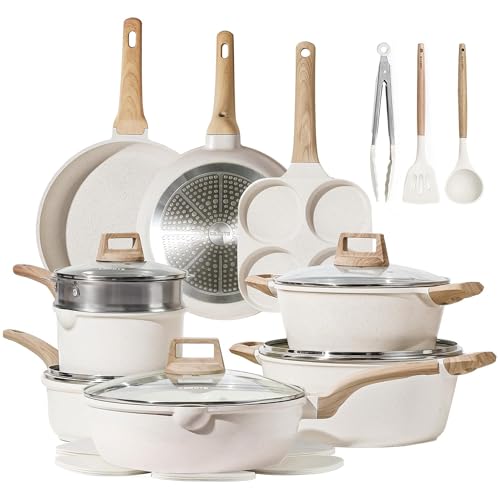
Pros
- Compatible with all cooktops including induction
- Lightweight die-cast aluminum construction heats quickly
- Includes four pan protectors plus basic cooking utensils
- Includes 12-month manufacturer warranty from purchase date
Cons
- Hand washing recommended instead of dishwasher use

Pros
- Detachable handles enable compact nesting
- Compatible with induction, gas, and ceramic cooktops
- PFOA-free nonstick coating ease cleaning

Pros
- Dishwasher-safe hard-anodized construction
- Thermo-Spot preheat indicator on frypans
- Oven safe up to 400 degrees Fahrenheit
- Includes specialty griddle and steamer insert
Cons
- Not compatible with induction stovetops
- Lids only oven safe to 350 degrees Fahrenheit

Pros
- Compatible with induction, gas, electric, and ceramic stoves
- Pre-installed stay-cool Bakelite handles require no assembly
- Comprehensive 31-piece bundle covers cooking and baking needs
- Stackable carbon steel bakeware minimizes cabinet clutter
Cons
- Hand washing required; not dishwasher safe
- Metal utensils and abrasive cleaners damage nonstick coating

Pros
- Works on induction and all standard cooktops
- Coating free of PTFE, PFOA, PFAS, and lead
- Thick 4.8mm base heats quickly and evenly
- Stay-cool Bakelite handles provide comfortable grip
Cons
- Hand washing recommended to protect nonstick surface
Coating Chemistry and Heat Tolerance
Coating composition determines surface safety under elevated temperatures. Overheated fluoropolymer surfaces break down above 500 degrees Fahrenheit, creating nonstick cookware toxic exposure hazards. Traditional PTFE formulations now exclude PFOA, yet ceramic options use mineral-based silica coatings entirely free of PFAS, PTFE, and heavy metals. Ceramic options offer peace of mind during high-heat cooking but show reduced slickness faster than reinforced PTFE surfaces over extended use.
Buyers seeking alternative pans can explore stainless steel cookware for high-heat searing without coating breakdown risks. Verify manufacturer safety statements regarding cadmium, lead, and fluorochemicals before purchase.
Base Metal Construction and Heat Distribution
Core metal determines pan stability and heat transfer speed. Die-cast aluminum and hard-anodized aluminum distribute heat evenly across pan bottoms, eliminating localized hot spots. Hot spots accelerate nonstick degradation and cause food scorching. Hard-anodized bodies resist warping under thermal shifts, preserving pan contact with flat burner surfaces.
Stovetop and Induction Compatibility
Cooktop compatibility hinges on pan base engineering. Standard aluminum pans fail on induction ranges without magnetic base plates. Induction-ready pans feature bonded stainless steel bottom plates, ensuring rapid heating across gas, electric, and magnetic induction burners. Compare options across broader cookware sets to match specific range types before ordering.
Handle Construction and Oven Limits
Handle design affects kitchen workflow, cabinet storage, and oven utility. Fixed Bakelite handles stay cool on stovetops but carry lower oven temperature thresholds. Riveted silicone-wrapped stainless handles support oven use up to specified limits, such as 400 degrees Fahrenheit. Detachable handle systems maximize cabinet storage efficiency and enable seamless pan placement into compact ovens or refrigerators.
Cleaning Protocol and Surface Longevity
Dishwasher detergents contain harsh abrasives that erode nonstick coatings prematurely. Gentle hand washing using soft sponges preserves release integrity and prevents bare metal exposure. Cookware with smooth exterior finishes cleans rapidly using warm water and mild soap. Dedicated cooks seeking specialized searing pans can compare dedicated options via everyday frying pans.
How We Compared These Products
Our evaluation relies on published manufacturer specifications, listed materials, coating compositions, base dimensions, handle configurations, and documented customer feedback. We analyzed pieces without hands-on lab testing or firsthand cooking trials. Research focuses on practical kitchen trade-offs including induction support, oven limits, storage constraints, and declared chemical exclusions.
Which Option Fits Your Kitchen?
Compact Storage and RV Kitchens
For tiny kitchens or RV living, Astercook 21 Pcs Pots and Pans Set Non Stick offers detachable handle engineering. Removable handles let pans nest inside tight cabinets effortlessly. Aluminum construction ensures uniform heating across induction, gas, and ceramic cooktops, while chemical-free nonstick coating supports simple cleanup.
Mineral-Based Ceramic Cooking
Cooks focused on eliminating fluoropolymers entirely should consider SENSARTE Ceramic Cookware Sets. Listing details confirm construction free of PTFE, PFAS, PFOA, lead, and cadmium. Set includes 4.8mm stainless bottom plates for induction readiness alongside ergonomic wood-grain Bakelite handles.
All-In-One Kitchen Outfitting
Outfitting whole kitchens from scratch requires versatile piece selections. Pots and Pans Set Non Stick supplies 31 total pieces including saucepans, grill pans, silicone utensils, and carbon steel bakeware. Pre-assembled Bakelite handles eliminate tool assembly, and stainless induction plates support every standard cooktop.
Frequently Asked Questions
What makes nonstick cookware toxic during cooking?
Toxic risks occur when fluoropolymer coatings exceed recommended temperature thresholds. Extreme heat causes PTFE breakdown, releasing fumes capable of causing flu-like symptoms in humans and severe harm to pet birds. Cooking over medium heat and avoiding empty preheating minimizes coating damage.
Are ceramic nonstick coatings safer than PTFE coatings?
Ceramic coatings utilize silica-derived mineral compounds rather than synthetic fluorochemicals. They contain zero PTFE, PFOA, or PFAS substances. Ceramic surfaces withstand moderate overheating without releasing fluoropolymer fumes, though nonstick slickness may degrade faster than fluoropolymer coatings under heavy use.
How can cooks prevent nonstick coating damage?
Use wooden or silicone utensils instead of metal forks and spatulas. Avoid abrasive scouring pads and harsh automatic dishwasher cycles. Cook over low to medium flame settings, and allow pans to cool fully before washing to prevent thermal shock warping.
Can nonstick pans work on induction cooktops?
Only pans with magnetic steel bottom plates function on induction surfaces. Pure aluminum cookware lacks magnetic properties required for induction heating. Check manufacturer specifications for magnetic stainless steel base plates before buying.
When should scratched nonstick pans get replaced?
Pans showing peeling, deep gouges, or flaking surfaces require replacement. Flaking coatings mix particles into food, while exposed bare metal compromises even heating and food release.
Can nonstick cookware go inside home ovens?
Oven safety depends on handle composition and coating formulas. Pans with riveted metal handles often tolerate oven temperatures up to 400 degrees Fahrenheit. Cookware with plastic or Bakelite handles typically requires removal or lower heat limits. Always check exact model specifications prior to oven cooking.


Write Your Review
No reviews yet. Be the first to share your experience!