

A dull kitchen knife makes prep less pleasant, but sharpening it can feel like a project if you are not comfortable managing a whetstone’s angle. The best rolling knife sharpener for your kitchen depends on the edge angle you want, the abrasives included, and how much room you have to store a kit.
This comparison looks at two rolling systems with 15- and 20-degree supports. Use the details below to compare their sharpening and honing components, consider which knives they suit, and decide what to check before buying.

How to Choose the Best Rolling Knife Sharpener
Choose an angle that suits your knife
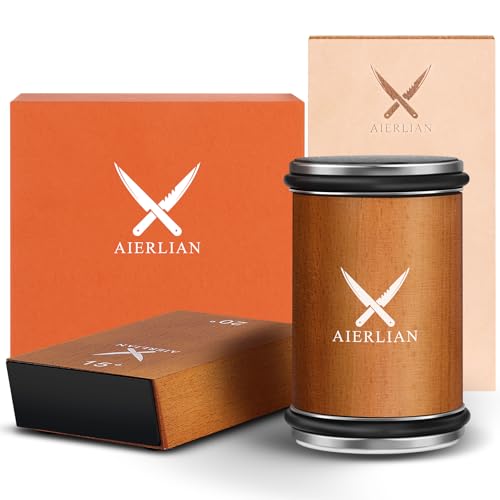
A fixed-angle support helps guide the blade consistently, but it also limits your choices to the angles included. Both AIERLIAN and TUMBLER specify 15- and 20-degree supports. AIERLIAN describes 20 degrees as suitable for most household kitchens and 15 degrees for a sharper edge; treat that as the brand’s guidance, not a guarantee for every blade.
Before choosing, check the angle recommended for your knife and whether its blade can sit securely against the magnetic support. If you own knives with different edge geometries, a kit with only two fixed options may not match every blade. For a broader look at sharpening styles, see our guide to professional knife sharpener types.
Compare the abrasive and honing steps
The abrasive affects what the sharpener is designed to do, while a finishing step can help refine the edge. AIERLIAN specifies a #400 diamond disc and a #3000 ceramic disc, plus a leather strop. Its described sequence is to sharpen with diamond, polish with ceramic, then use the strop to refine the edge.
TUMBLER specifies a diamond-plated disc and a stainless steel helix disc that the manufacturer says hones and refines the blade. The exact grit ratings are not listed for these components. If you prefer a stated grit sequence and a separate strop, AIERLIAN spells those out; if you are comparing the honing design, check what TUMBLER’s helix disc is intended to do for your maintenance routine.
Check blade compatibility before sharpening
Rolling systems are intended for supported blade shapes and edges, not every cutting tool in a drawer. AIERLIAN specifically excludes serrated knives and scissors. TUMBLER describes use with kitchen, chef, field, utility, and specialty knives, but that general claim does not establish compatibility with every blade material or shape.
Check the manufacturer’s guidance for your particular knife before sharpening, especially if it is serrated, unusually shaped, or made from a blade material you are unsure about. If you are choosing knives as well as care tools, our guide to Japanese chef knives and blade care offers related buying context.
Consider the base, magnets, and storage routine
Both products use a magnetic support and a wood base, so you will need a stable surface and a place to store the components together. AIERLIAN specifies four N42 magnets in its support; TUMBLER describes powerful magnets but does not give a count. Those details may matter if you want to understand how each system is designed to hold a blade, but they do not replace checking that your knife sits securely.
A rolling kit takes up storage space compared with a compact pull-through tool, and its parts need to be kept together. Neither product’s cleaning method or dimensions are specified here. If you have limited drawer or counter space, confirm the kit’s footprint and care instructions before deciding. For ideas about organizing knives and their care, see our knife block and storage guide.
Weigh ease of use against control
Both brands describe a rolling process guided by a magnetic angle support, which may appeal if you want a repeatable guide rather than holding a knife at a freehand angle. A guided system still requires careful blade placement and use according to its instructions. It is not automatically suitable for every knife or a substitute for checking the edge angle.
AIERLIAN emphasizes a diamond-to-ceramic sequence followed by a leather strop. TUMBLER describes rolling with its diamond disc and honing with the helix disc. Choose based on which steps you are comfortable following and which finishing components you want to maintain.
How We Compared These Products
We compared the manufacturers’ stated angle options, abrasive and honing components, magnetic supports, and intended blade uses. The comparison also considers practical fit: whether the sharpening sequence suits your routine, whether your knives appear compatible, and what you should confirm about storage and care before choosing.
Which Option Fits Your Kitchen?
Choose a defined abrasive sequence: The AIERLIAN Knife Sharpener Tool specifies a #400 diamond disc, #3000 ceramic disc, and leather strop, as well as 15- and 20-degree supports. Its trade-off is that it explicitly excludes serrated knives and scissors, so skip it if those are the tools you need to sharpen.
Consider a helix honing disc: The The Original Tumbler Rolling Knife Sharpener™ pairs a diamond-plated disc with a stainless steel helix disc and offers 15- and 20-degree supports. The manufacturer describes several intended knife types, but does not specify grit ratings for the discs. Skip it if you need published grit specifications to choose your sharpening sequence.
Need a specific angle or storage fit? Both kits offer the same two angle choices, so neither has an advantage on that point. Confirm your knife’s recommended edge angle, the kit’s dimensions, and its care instructions before ordering. If your main priority is fitting a blade outside those stated angles, compare other sharpening styles rather than assuming either rolling kit will match it.
Frequently Asked Questions
Can I use either sharpener on any kitchen knife?
No universal compatibility is established. AIERLIAN excludes serrated knives and scissors, while TUMBLER names several intended knife types without confirming every blade shape or material. Check the manufacturer’s guidance for your specific knife before sharpening.
What is the difference between the 15- and 20-degree supports?
They guide sharpening at different edge angles. AIERLIAN describes 20 degrees as suited to most household kitchens and 15 degrees for a sharper edge, but the right angle depends on the knife. Check the knife maker’s recommendation rather than changing an edge angle by guesswork.
What abrasive components does each kit use?
AIERLIAN specifies #400 diamond and #3000 ceramic discs, plus a leather strop. TUMBLER specifies a diamond-plated disc and a stainless steel helix disc for honing and refining, without listing grit ratings for those parts.
Are these sharpeners suitable for serrated knives?
AIERLIAN explicitly says its system is not for serrated knives. TUMBLER’s listed intended uses do not confirm serrated-blade compatibility, so verify with the manufacturer rather than using it on one by assumption.
How should I clean the rolling sharpener?
Specific cleaning instructions are not listed for these kits. Check the instructions from the manufacturer for each model before cleaning its discs, magnetic support, or wood components, and do not assume the parts are dishwasher-safe.
Will a rolling sharpener fit in a small kitchen?
Both are kits with a base and sharpening components, but dimensions are not specified. If drawer space is tight, check each product’s footprint and storage guidance before buying; a guided rolling system may need more room than a compact handheld sharpener.





Write Your Review
No reviews yet. Be the first to share your experience!